Virtual Tumor Board
An AI tumour board: a panel of specialist agents that reviews a cancer case the way a multidisciplinary team would, so patients far from major cancer centres can still get an expert, guideline-based treatment plan.
In the news
Times of India · Times Techies: AI for Social Impact
The Virtual Tumor Board was covered by the Times of India in their Times Techies: AI for Social Impact feature. Grateful for the coverage—it was encouraging to see interest in using AI for improving cancer care access.
Read the article →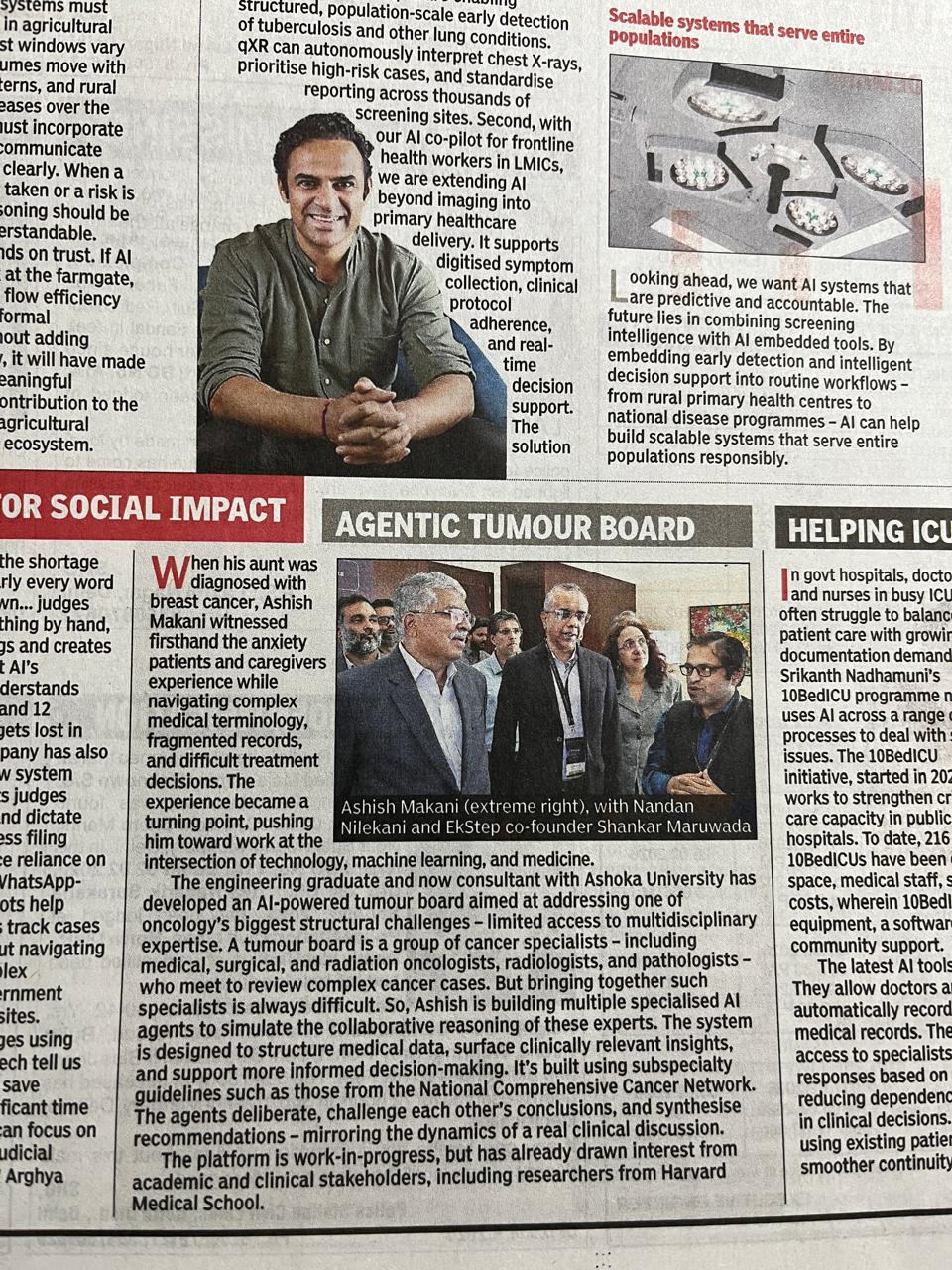
The problem
The best cancer outcomes come from tumour boards: medical, surgical and radiation oncologists, radiologists and pathologists reviewing a case together and agreeing on a plan. Getting all of those specialists in one room is hard even in a large hospital, and for most patients in India it never happens.
The result is delayed diagnoses, plans that drift from the evidence, and avoidable deaths, especially outside the major metros.
Why this matters to me
When my aunt was diagnosed with breast cancer, her staging MRI showed a lesion in a vertebra. The radiology report read: “sclerotic change, possibly age-related, cannot rule out metastatic disease.”
That one sentence was the difference between Stage II, which is curable, and Stage IV, which is not.
Through family connections we got her case in front of senior specialists. They concluded the lesion was benign, and she received curative treatment. Most patients don't have those connections, can't travel to a metro, and can't pay for several specialist opinions. I'm building this so the second opinion doesn't depend on who you know.
How it works
The system runs a panel of specialised AI agents, each reasoning from its own subspecialty, to simulate the collaborative reasoning of a real tumour board.
- Medical oncology
- Surgical oncology
- Radiation oncology
- Radiology
- Pathology
- Structure the caseReports, scans and notes, often fragmented across documents, are organised into one clinical summary.
- Review by each specialistEvery agent assesses the case against subspecialty guidelines such as those from the National Comprehensive Cancer Network (NCCN).
- Deliberate and challengeThe agents debate, question each other's conclusions and flag uncertainty, as clinicians do in a real discussion.
- Synthesise a recommendationThe panel produces a treatment plan with its reasoning and evidence, aware of local drug availability and cost, for the treating oncologist to review.
What it's for
Faster decisions
Cut the time from diagnosis to a reviewed treatment plan from weeks to minutes.
Consistent quality
Evidence-based recommendations aligned with international guidelines.
Local context
Aware of drug availability, costs and insurance coverage in India.
Reach
Decision support for oncologists in tier-2 and tier-3 cities and rural hospitals.
Where it stands
There is a working prototype, evaluated so far on synthetic cases. It has drawn interest from academic and clinical stakeholders, including researchers at Harvard Medical School.
I'm looking for:
- Clinical validation partners: oncology departments interested in piloting on real cases
- Health systems that want to extend or standardise multidisciplinary review
- Oncologists in underserved areas who would use decision support day to day
- Investors in India-focused healthtech and precision oncology
Interested? Let's talk.
Happy to share more detail under NDA.
Disclaimer: research prototype, not for clinical use without physician oversight.