<?xml version="1.0" encoding="utf-8"?><feed xmlns="http://www.w3.org/2005/Atom" ><generator uri="https://jekyllrb.com/" version="3.10.0">Jekyll</generator><link href="https://inventcures.github.io/essays/feed.xml" rel="self" type="application/atom+xml" /><link href="https://inventcures.github.io/" rel="alternate" type="text/html" /><updated>2026-11-04T19:48:53+05:30</updated><id>https://inventcures.github.io/essays/feed.xml</id><title type="html">tp53(ashish)’s home on the interwebs | Essays</title><subtitle>personal description</subtitle><author><name>tp53(ashish)</name><email>spiff007 (@ the free email service from Google)</email></author><entry><title type="html">Curing All Disease, Ahead of Schedule: Permission to dream bigger with complementary AI–human teams</title><link href="https://inventcures.github.io/cure-em-all/" rel="alternate" type="text/html" title="Curing All Disease, Ahead of Schedule: Permission to dream bigger with complementary AI–human teams" /><published>2026-11-04T00:00:00+05:30</published><updated>2026-11-04T00:00:00+05:30</updated><id>https://inventcures.github.io/cure-em-all</id><content type="html" xml:base="https://inventcures.github.io/cure-em-all/"><![CDATA[<blockquote>
  <p><strong>A note before we start.</strong> This post is my attempt to synthesize and integrate the flood of commentary around the last few weeks in bio × AI: three frontier-lab acquisitions, a fresh round of essays and threads from people I’ve learned a great deal from (Alex Araki, Bruce Booth, Simon Barnett, Jeb Keiper, Egan Peltan, Alex Telford, Robert Plenge, Abhishaike Mahajan and others), and the old questions underneath all of it. It is commentary on recent events, and commentary on the commentary. Links are inline so you can read the originals, which are better than my summaries.</p>
</blockquote>

<hr />

<h2 id="1-an-owl-a-ted-talk-and-a-lottery-ticket">1. An Owl, a TED talk, and a lottery ticket</h2>

<p>I owe this whole line of thinking to the brilliant <strong>Abhishaike Mahajan</strong>, who writes <a href="https://www.owlposting.com/">Owl Posting</a>. In April he published <a href="https://www.owlposting.com/p/curious-cases-of-financial-engineering">“Curious cases of financial engineering in biotech”</a>, a 7,000-word tour of royalties, synthetic royalties, priority review vouchers, CVRs, hub-and-spoke holding companies and the zombie-biotech liquidation trade. It contains one of the best one-line descriptions of biotech I have read:</p>

<blockquote>
  <p>“For $250 million and ten years of your life, you may purchase a lottery ticket.”</p>
</blockquote>

<p>Somewhere in that essay Mahajan links a TED talk and tells you to watch the whole thing. I did, and it is now, without much competition, my favorite TED talk of all time: MIT economist <strong>Andrew Lo</strong>’s <a href="https://singjupost.com/andrew-lo-can-financial-engineering-cure-cancer-at-tedxcambridge-transcript/">“Can Financial Engineering Cure Cancer?”</a> at TEDxCambridge.</p>

<p>Lo opens with grief. He has lost friends, colleagues and his mother to cancer, and he says, simply: <em>“I’m sick and tired of losing friends and family to cancer, and I don’t accept it and neither should you.”</em> Then he does what a finance professor does. He prices the lottery ticket.</p>

<p>His toy numbers (from the talk) go roughly like this:</p>

<ul>
  <li>One cancer drug candidate costs about <strong>$200M</strong>, takes about <strong>10 years</strong>, and has roughly a <strong>1-in-20</strong> chance of paying off. If it does, it is worth about <strong>$12.3B</strong>.</li>
  <li>Nobody sane puts their retirement into one of those tickets. The variance is brutal.</li>
  <li>But buy <strong>150</strong> of them, a <strong>~$30B</strong> “megafund”, and the probability of at least three hits is about <strong>98%</strong>, worth roughly <strong>$37B</strong> by year 10.</li>
</ul>

<p>Pool enough independent long shots and a lottery ticket becomes something closer to a bond. Once it looks like a bond, you can sell bonds against it to pension funds and insurers, a pool of capital orders of magnitude larger than biotech venture. Lo even reaches for World War II war bonds as the precedent for asking ordinary people to finance a moonshot. A biotech CSO once told him, <em>“Our financing drives our scientific agenda,”</em> and the whole talk is an argument that we can flip that around. He closes: <em>“We can do well, by doing good.”</em></p>

<p>Mahajan’s essay is the sober sequel. The megafund was never built for clinical-stage assets. His diagnosis: biotech isn’t used to debt, and there is no “biomedical Moody’s” to rate a pool of drug programs and no “biomedical Fannie Mae” to standardize and buy the loans, the institutions that made the 30-year mortgage possible in the 1930s. He also notices something uncomfortable: every clever financial tool that makes biotech risk tradable favors <strong>legible</strong> projects (small trials, clear genetics, fast regulatory paths), and so <em>“the money increasingly, naturally flows to them and nowhere else.”</em></p>

<p>Hold onto both ideas, <strong>portfolio</strong> and <strong>legibility</strong>. They are the two threads running through everything that follows.</p>

<h3 id="why-this-matters-in-one-calculation">Why this matters in one calculation</h3>

<p>The power of the portfolio idea, and its fragility, fits in a few lines:</p>

<div class="language-plaintext highlighter-rouge"><div class="highlight"><pre class="highlight"><code>One program:       P(success) = 10%        → 90% chance you lose everything
100 programs:      P(zero successes) = 0.9^100 ≈ 0.003%
                   P(≤ 2 successes) ≈ 0.2%  → bond-like

But make them correlated (half the time a shared assumption is wrong
and every program drops to 3%; otherwise 17%; same 10% average):
                   P(≤ 2 successes) ≈ 21%   → 100x riskier
</code></pre></div></div>

<p>Same average, completely different risk. Pooling only works if the bets are genuinely different bets. Remember that when we get to herding.</p>

<hr />

<h2 id="2-fast-forward-drugs-that-died-at-least-once">2. Fast forward: drugs that died at least once</h2>

<p>Lo’s talk is about money. But money is only half of why good drugs don’t get made. The other half is attention: who looks at what, and when they stop looking.</p>

<p>Egan Peltan, in his essay <a href="https://blog.egan.bio/p/pipeline-in-a-person-will-help-ai">“Pipeline-in-a-Person will help AI…”</a>, has a line I can’t shake: <em>“The average drug you take likely died at least once.”</em> Two examples make the point better than any statistic.</p>

<p><strong>Keytruda.</strong> The world’s best-selling drug started life as an Organon antibody program around 2003, originally aimed at autoimmune disease. Organon was bought by Schering-Plough in 2007, Schering-Plough by Merck in 2009, and through all of it the PD-1 program ranked near the bottom. Merck shut it down and put it on the out-license list; a term sheet to hand the rights away for very little was reportedly drafted. What saved it in 2010 was a competitor: BMS’s positive Phase 3 ipilimumab data and early nivolumab signals made Merck look again. The term sheet was pulled, the IND was filed in December 2010, and pembrolizumab went on to become Keytruda (<a href="https://www.forbes.com/sites/davidshaywitz/2017/07/26/the-startling-history-behind-mercks-new-cancer-blockbuster/">Forbes, David Shaywitz</a>; see also <a href="https://www.science.org/content/blog-post/keytruda-story">Derek Lowe’s “The Keytruda Story”</a>). The molecule never changed. The attention did.</p>

<p><strong>Ojemda.</strong> Tovorafenib was discovered at Sunesis, licensed to Millennium/Takeda as TAK-580, and then stalled when adult development stopped. Pediatric-cancer champions inside Takeda pushed to out-license rather than shelve it (<a href="https://www.dayonebio.com/giving-new-life-to-medicines-article/">Day One</a>). Day One, a company built specifically to find drugs with pediatric potential that lacked an adult path, acquired it in December 2019. There was already lab evidence in pediatric brain tumors and a tiny nine-patient academic trial funded by families through the Pediatric Low Grade Astrocytoma Foundation (<a href="https://www.pcrf-kids.org/2024/02/16/special-guest-author-blackman/">Sam Blackman, PCRF</a>). FDA accelerated approval came in April 2024, for children with relapsed or refractory pediatric low-grade glioma, and Servier agreed to acquire Day One in 2026.</p>

<p><strong>Ibrutinib, and then acalabrutinib.</strong> The third and fourth case studies come as a pair, and they are the subject of Nathan Vardi’s wonderful book <a href="https://www.shortform.com/summary/for-blood-and-money-summary-nathan-vardi"><em>For Blood and Money: Billionaires, Biotech, and the Quest for a Blockbuster Drug</em></a> (2023).</p>

<p><em>Case 3: Imbruvica.</em> In the mid-2000s Celera Genomics was winding down its drug research. Among the leftovers was a covalent inhibitor of BTK, a kinase in B cells, that its chemists had made largely as a research tool. In April 2006 Pharmacyclics, a struggling company whose lead brain-cancer drug had just disappointed, bought Celera’s BTK, HDAC and Factor VIIa programs for <strong>$2 million in cash plus 500,000 to 1 million shares</strong>, with milestones and royalties on top (<a href="https://www.biospace.com/pharmacyclics-inc-buys-drug-candidates-from-celera-genomics">BioSpace</a>). Under investor-turned-CEO Bob Duggan, that molecule, PCI-32765, became <strong>ibrutinib</strong>. J&amp;J’s Janssen partnered on it in late 2011, the FDA approved it as Imbruvica in November 2013, and in March 2015 <strong>AbbVie agreed to buy Pharmacyclics for $21 billion</strong> after a bidding war with J&amp;J (<a href="https://www.biospace.com/inside-the-21-billion-bidding-war-for-pharmacyclics">BioSpace</a>). Duggan alone received more than $3.5 billion (<a href="https://en.wikipedia.org/wiki/Pharmacyclics">Wikipedia</a>). A few million dollars of discarded chemistry turned into one of the largest biotech acquisitions ever.</p>

<p><em>Case 4: Calquence.</em> Ibrutinib worked, but it hit other kinases too, which drove side effects such as atrial fibrillation and bleeding. Several people who had helped develop it, including Ahmed Hamdy and Raquel Izumi, left Pharmacyclics convinced a more selective BTK inhibitor would be better. They found one in the Netherlands: chemist Tjeerd Barf and biologist Allard Kaptein in Oss, the old Organon research town that also produced Keytruda, had designed a more selective BTK inhibitor and kept it alive after their own research program was shut down (<a href="https://acertapharma.netlify.app/">Acerta history</a>). Acerta Pharma formed in early 2013, backed in part by hedge-fund manager Wayne Rothbaum, an early Pharmacyclics investor. Its first trial started in 2014, and in December 2015 <strong>AstraZeneca paid $4 billion for 55% of Acerta</strong>, with an option on the rest for about $3 billion more (<a href="https://businesswire.com/news/home/20151216006501/en/Acerta-Pharma-Announces-Strategic-Transaction-with-AstraZeneca">Business Wire</a>). Acalabrutinib was approved as Calquence in 2017, and AstraZeneca bought out the remainder in 2021. By 2025 Calquence was selling roughly <strong>$3.5 billion a year</strong> (sum of regional sales in <a href="https://www.sec.gov/Archives/edgar/data/901832/000110465926019130/azn-20251231x20f.htm">AstraZeneca’s 2025 annual report</a>).</p>

<p>The BTK pair teaches two lessons at once. Imbruvica is the shelved-asset lesson: a large organization’s leftovers, picked up cheaply by people who looked harder. Calquence is a fast follower done <em>right</em>: a second molecule against a target the first had just validated, winning on selectivity and safety rather than novelty. Keep that in mind for the next section. Fast-following is not the problem. Thirty fast followers on the same target, all hoping to be the Calquence, is.</p>

<p>All four stories share a structure. A good molecule sat inside an organization whose priorities pointed elsewhere, or was left behind when a program closed. It took an outside event (a competitor’s data) or an outside team (people who looked where others weren’t looking) to bring it back. That is, in miniature, the original <strong>Roivant</strong> thesis: big pharma has many molecules it has shelved for reasons that have nothing to do with whether they work, so in-license them, put each in its own subsidiary with its own team and equity, and give it the attention it never got. (Alex Araki tells this story well in <a href="https://alexaraki.substack.com/p/roivant-was-ahead-of-its-time">“Roivant was ahead of its time”</a>.)</p>

<hr />

<h2 id="3-the-herd">3. The herd</h2>

<p>If good ideas die for lack of attention, where is the attention going instead? Increasingly, to the same few places.</p>

<p><strong>Alex Telford</strong> (<a href="https://convoke.bio">Convoke</a>) posted a chart from an upcoming post that stopped me cold (<a href="https://x.com/Atelfo/status/2116288011533164643">X, Oct 30</a>):</p>

<blockquote>
  <p>“&lt;5% of new drugs entering the clinic are going after targets that haven’t been tested clinically before, ~60% are going after targets with an approved drug. New ideas are hard to find!”</p>
</blockquote>

<p>In Convoke’s data, of roughly 551 new drugs entering the clinic in 2026 (through late October), about 326 went after a target that already has an approved drug and only about <strong>20</strong> went after a target never tested in humans. In 2005, roughly one in five new clinical drugs was a genuinely new-target bet. This year it is roughly one in 28.</p>

<p>This is not a new observation, and it is not AI’s fault. A 2023 analysis in <em>Nature Reviews Drug Discovery</em>, <a href="https://www.nature.com/articles/d41573-023-00063-3">“Herding in the drug development pipeline”</a> (Fougner, Cannon, The, Smith and Leclerc), found that the average number of clinical assets per actively pursued target <strong>more than doubled, from about 3 in 2000 to about 7 in 2022</strong>. Among the top ten pharma companies, the share of targets with more than five assets in development rose from <strong>16% to 68%</strong>. Herding even shows up in rare monogenic disease: fully enrolling every active study in Duchenne, thalassaemia or Huntington’s would require more than 10% of the US patient population.</p>

<p>What herding costs is now being counted in patients, not just dollars. A February 2026 paper in <em>BMJ Oncology</em> (<a href="https://pmc.ncbi.nlm.nih.gov/articles/PMC12911736/">Zhang, Osipenko and Hickman</a>) tallied <strong>220 trials of 30 TIGIT inhibitors from 21 companies</strong>, enrolling about <strong>49,000 patients</strong> at an estimated <strong>$3.1 to 3.6 billion</strong>, with no TIGIT inhibitor approved as of November 2025. Their conclusion is blunt: <em>“herding amplifies the loss of human and financial resources incurred during drug development.”</em></p>

<p><strong>Robert Plenge</strong> (BMS) gave the phenomenon its best name in <a href="https://plengegen.com/blog/moloch/">“Breaking from the Herd: How Biopharma Can Escape Moloch’s Trap”</a>: <em>“Target crowding (or herding) is a canonical Moloch’s trap,”</em> a coordination failure where <em>“no individual is the villain, yet everyone is complicit.”</em> Each company’s choice is rational. Validated biology with a causal, disease-driving mechanism really is less risky, and fast-following really does work (Ozempic was not the first GLP-1 drug; Byetta was). Add them all up and you get dozens of programs on the same handful of targets, competing for the same patients, with lower exit prices for everyone after the first few.</p>

<p><strong>Egan Peltan</strong> put the market version of this in a single post (<a href="https://x.com/EganPeltan/status/2115806359413305650">X</a>): <em>“the sector has been on a risk-off posture for the past half decade. There are high quality FiC programs passed up for Nth-in-class Chinese programs at generous valuations… Opportunity for brave generalists.”</em></p>

<p>And then <strong>Bruce Booth</strong> made the argument that matters most for this post. In <a href="https://lifescivc.com/2026/10/the-fruits-of-ai-drug-abundance-indigestion-in-the-near-term/">“The fruits of AI drug abundance: indigestion in the near term”</a> he notes the industry has already brought <em>“over 100 global programs into R&amp;D against each of the top eight targets,”</em> and warns: <em>“AI will undoubtedly exacerbate the crowding challenge in our sector… we should be prepared for a tsunami of programs against validated biology.”</em> AI is democratizing molecular design, mostly <em>around what we already know</em>. Booth calls himself a long-time AI believer; his argument is about timing. Genomics flooded the industry with poorly validated targets before it paid off, and he expects AI to make R&amp;D productivity worse for the next three to five years before it makes it better. Novel AI-driven programs exist, <em>“but they are the exception rather than the norm.”</em></p>

<p>Simon Barnett of Dimension made the same point on Endpoints’ live show, citing Booth: the activation energy to create compounds is falling so fast that the first effect is likely to be <em>more</em> target crowding (<a href="https://www.youtube.com/watch?v=xZQ8Bn27V1s&amp;t=2132s">Endpoints, 35:32</a>).</p>

<p>Now connect this back to Lo. Herding is correlation. Twenty programs on the same target are not twenty independent lottery tickets; they are closer to one ticket bought twenty times. The megafund math only works on genuinely different bets, and the industry has spent twenty years making its bets more alike.</p>

<hr />

<h2 id="4-three-acquisitions-in-seven-months">4. Three acquisitions in seven months</h2>

<p>Against that backdrop, the frontier labs started buying biotechs.</p>

<p><strong>Anthropic acquires Coefficient Bio (April 2026).</strong> A New York startup founded in 2025, reportedly about six people, bought for roughly <strong>$400M in stock</strong> (<a href="https://www.fiercehealthcare.com/biotech/anthropic-acquires-stealth-ai-startup-coefficient-bio-400m-deal">Fierce Healthcare</a>). One co-founder, Joyce Hong, spent nearly five years as a principal at Roivant. It is hard to invent a neater link between the old hub-and-spoke and the new one.</p>

<p><strong>OpenAI acquires Orchestra Bio (October 20, 2026).</strong> Orchestra is a platform that helps biopharma teams coordinate the sprawling operational work of drug development: studies, vendors, timelines. OpenAI is folding it into <strong>Rosalind</strong>, its life-sciences models and tools (<a href="https://x.com/OpenAI/status/2112607347688583586">OpenAI on X</a>; <a href="https://runtimewire.com/article/openai-acquires-orchestra-bio-drug-development-operations">RuntimeWire</a>). Founder <strong>Ashoka Rajendra</strong> joins OpenAI. Terms weren’t disclosed. Peltan, who used Orchestra for his own lean program, describes its real contribution as a data model that makes a drug program legible to AI agents, not just to human experts.</p>

<p><strong>Anthropic acquires Mithril Medicine (announced October 27, 2026).</strong> This is the one that broke BioTwitter. Mithril was a one-person preclinical biotech, seeded by Atlas Venture, founded by <strong>Cody Tranbarger</strong>, who revealed in the same breath that he is <strong>@Prof_Oak_</strong>, the pseudonymous biotech commentator many of us have read for six years (<a href="https://x.com/Prof_Oak_/status/2115185849424048564">his reveal thread</a>).</p>

<p>What Mithril actually built, per <a href="https://www.anthropic.com/research/early-progress-drug-development">Anthropic’s announcement</a> and <a href="https://www-cdn.anthropic.com/52e1f5d50c47ca3818f56704c27cf19e59b62e77.pdf">technical report</a>:</p>

<ul>
  <li><strong>The diseases.</strong> Two rare, genetic, childhood muscle diseases: <strong>LAMA2-related congenital muscular dystrophy (LAMA2-CMD</strong>, also called merosin-deficient CMD, caused by loss of laminin-α2) and the <strong>α-dystroglycanopathies</strong>, where the sugar chain on α-dystroglycan that grips the surrounding matrix is missing. (These are congenital muscular dystrophies, not spinal muscular atrophy, which is a different disease with a different cause.)</li>
  <li><strong>The idea.</strong> Bispecific “bridging” antibodies that act like a mechanical clamp: one arm grabs β-dystroglycan on the muscle fiber, the other grabs laminin in the basement membrane, physically reconnecting what the mutation disconnected.</li>
  <li><strong>The operating model.</strong> Tranbarger used Claude to coordinate contracts, logistics and experiments across <strong>11 external labs</strong>, with five CROs characterizing a 113-construct panel and a bench of eight part-time scientific consultants. Idea to promising mouse data took <strong>under 18 months</strong>.</li>
  <li><strong>The data, honestly labeled.</strong> In a six-week pilot in a LAMA2-deficient mouse model, the best tool molecule roughly doubled peak muscle force versus vehicle. It was not GLP, not blinded, not randomized, and not yet peer-reviewed, and the authors say so. No formal drug candidate is named yet; Anthropic hopes to name candidates in 2027 and reach human trials for LAMA2-CMD as soon as late 2028.</li>
</ul>

<p>Tranbarger’s own framing is the part I keep rereading: <em>“Will AI x Bio cure diseases? Unequivocally yes, imo… but not by the route that gets the most airtime. Rather than timeline acceleration &amp; compression, I see orchestration &amp; parallelization as today’s low-hanging fruit.”</em> Most drug hunters, he notes, see a handful of go/no-go calls in a career and spend the rest trading emails. <em>“Give them the bandwidth to run several programs at once, and the time to focus on scientific judgment, and I’m willing to bet they’ll make better calls.”</em> He calls this <strong>Pipeline-in-a-Person</strong>, an idea developed with the Coefficient team earlier this year, and he signs off: <em>“Gotta Cure ‘Em All.”</em></p>

<p>The day after, Alex Araki connected the dots (<a href="https://x.com/alexsaraki/status/2115482839651328137">X</a>): these three deals <em>“all point towards one thing: The new macro-consensus in biotech is the AI ‘hub-and-spoke.’”</em> The frontier lab is the new mothership. Each acquired biotech is a spoke. And unlike the old Roivant, whose hub mostly shared capital and back-office overhead, the AI hub’s value is supposed to be <strong>learning</strong>: every program feeds data and know-how back into models that make the next program cheaper and better aimed.</p>

<p>Anthropic also announced six research partners alongside Mithril: BMS, Generate Biomedicines, BigHat, Divergence Labs, Enveda and The Column Group, whose new company Pleiades plans to use Claude to run many more programs than a small team usually could.</p>

<h3 id="not-only-the-labs-two-other-shapes-of-the-same-bet">Not only the labs: two other shapes of the same bet</h3>

<p><strong>Formation Bio’s $600M fund.</strong> On October 28, the day before Araki’s thread, Formation Bio CEO <strong>Benjamine Liu</strong> announced the <a href="https://www.benjamineliu.com/p/introducing-the-600m-formation-bio">Formation Bio Drug Development Accelerator Fund</a>: <strong>$600M</strong>, alongside Formation’s own balance sheet, to in-license and develop roughly <strong>10 to 15 assets over three to five years</strong>, two of them already licensed (<a href="https://runtimewire.com/article/formation-bio-600-million-drug-development-fund-ben-liu">RuntimeWire</a>). Each asset gets its own NewCo, sitting on top of Formation’s shared AI, development, regulatory, manufacturing and quality teams. AI is used to pick candidates, match them to indications, design trials and run development. Licensors get an upfront payment plus a share of milestones and royalties, and the money comes from research foundations, academic institutions, philanthropies and hospitals rather than only from VCs. Liu’s rationale is Araki’s in numbers: the count of discovered drug candidates has roughly doubled in a decade while yearly approvals have stayed flat, so <strong>development</strong>, not discovery, is the bottleneck, and more than $300B of pharma sales lose patent protection over the next decade. This is the closest thing yet to Roivant’s structure rebuilt with an AI layer, and to a small, mission-funded version of Lo’s megafund. It also implies something about cost: at an implied $40 to 60M per asset (my estimate from the fund size; Formation hasn’t disclosed a per-asset budget), the people who run trials for a living are budgeting far more per shot than the “$5M lean trial” sketches circulating on X.</p>

<p><strong>Capable.</strong> At the other end of the spectrum is <a href="https://capable.com/">Capable</a>, co-founded and led by <strong>Isaak Freeman</strong> (previously neuroscience at MIT and mathematics at Berkeley, per <a href="https://foresight.org/people/isaak-freeman/">Foresight</a>). Capable’s tagline is <em>“turning frontier intelligence into frontier medicines,”</em> and its thesis is almost the mirror image of Pipeline-in-a-Person: <em>“Frontier models won’t be bottlenecked by intelligence. They’ll be bottlenecked by the speed of data and active learning.”</em> So instead of orchestrating a network of outside labs, Capable is <strong>vertically integrated</strong>, with its own automated synthesis and testing loop for peptide and nucleotide therapeutics. Its first programs are in <strong>sleep</strong>, inspired by people with natural short-sleeper genetic variants, starting with rare disorders like narcolepsy and hypersomnia. In its <a href="https://progress.capable.com/p/202610">October update</a> Capable announced a <strong>$38M seed</strong> (Cathay, Abstract, Fidji Simo, Joe Betts-LaCroix, Andrej Karpathy and others; $50M raised to date), a lab expansion from 2,000 to 22,500 square feet in Mission Bay, and an automation setup that raised daily cell-assay throughput by more than 10x while cutting the coefficient of variation from 6% to about 1.75%. (A nice echo of Mahajan’s essay: Capable’s new BD advisor came from Centessa, the hub-and-spoke company that narrowed to a single sleep asset and sold to Lilly.)</p>

<p>Put Mithril, Formation and Capable side by side and you get three answers to the same question, <em>where should the learning loop live?</em> Mithril says: in one expert’s head plus a model, with the physical work rented from CROs. Formation says: in a shared development hub, with each asset financed and owned on its own. Capable says: in your own wet lab, because whoever generates the data fastest teaches the model fastest. I don’t think we know yet which is right, and it may be different for each modality and stage. That uncertainty is a good reason to want all three experiments running.</p>

<hr />

<h2 id="5-the-skeptics-are-mostly-right-about-the-right-things">5. The skeptics are mostly right, about the right things</h2>

<p>I want to give the skeptics real airtime, because the best ones are operators.</p>

<p><strong>Jeb Keiper</strong> (former Nimbus CEO) responded with three realities (<a href="https://x.com/JebKeiper/status/2115841057762000903">X</a>, expanded in <a href="https://jebkeiper.substack.com/p/the-myth-behind-the-n-of-1-biotech">“The Myth Behind the N of 1 Biotech”</a>): the “N of 1” biotech is an illusion, because a solo founder still surrounds themselves with capital partners, consultants and CROs; clinical trials aren’t going anywhere, because even a fully AI-designed drug’s first patient is still a first-in-human trial; and a “new use” is not a “new molecule.” All three are correct.</p>

<p>On Endpoints, a leader of an upper-midsize pharma company was quoted calling the one-employee biotech <em>“a stupid description that rests entirely on where you draw the corporate box”</em> (<a href="https://www.youtube.com/watch?v=xZQ8Bn27V1s&amp;t=1500s">Endpoints, 25:00</a>). Also fair. Mithril had one employee and eleven labs.</p>

<p>Simon Barnett’s reply is the one I find most useful. He doesn’t get bent out of shape about zero-person versus ten-person. What’s new is that <em>“spinning up voice agents to literally call CROs… didn’t exist 12 months ago,”</em> and that a lean team can now credibly prosecute something like ten ideas instead of one or two (<a href="https://www.youtube.com/watch?v=xZQ8Bn27V1s&amp;t=1592s">Endpoints, 26:32</a>, <a href="https://www.youtube.com/watch?v=xZQ8Bn27V1s&amp;t=832s">13:52</a>). Saving on salaries is not what makes or breaks this. <em>“Biotech and pharma it’s always been a bit of a numbers game… being able to have more legitimate shots on goal matters.”</em> And then the line that anchors the whole debate: skeptics will say <em>“the ultimate equalizer is the clinic”</em> (<a href="https://www.youtube.com/watch?v=xZQ8Bn27V1s&amp;t=1932s">32:12</a>).</p>

<p>So here is my synthesis of the skeptics and the optimists. AI is not (yet) compressing the parts of drug development that are bound by biology: how fast disease progresses, how long safety takes to show, how many patients exist. It is compressing <strong>coordination</strong>, the dead time between steps. Peltan makes this concrete with a rate-limiting-step argument. A toy version:</p>

<div class="language-plaintext highlighter-rouge"><div class="highlight"><pre class="highlight"><code>A first-in-class program:
  design 6 mo · animal validation 18 · waiting for a decision/funding 24
  Phase 1 18 · Phase 2 30                        → total 96 months

AI cuts design 6 → 1 month                       → 5% faster
Committed capital + fast decisions remove the 24-month wait → 25% faster
</code></pre></div></div>

<p>The impressive demo (faster design) barely moves the total. Removing the waiting moves it a lot. The Keytruda story is the same lesson at the scale of a decade.</p>

<hr />

<h2 id="6-so-who-does-what-in-this-world">6. So who does what in this world?</h2>

<h3 id="big-pharma">Big pharma</h3>

<p>Bruce Booth posted a Halloween thought experiment (<a href="https://x.com/LifeSciVC/status/2116604695800074576">X</a>) that I think is the most important thing written about this moment. He notes the frontier labs’ current bio bets are tiny, about 0.1% of their expected market caps, “small (and beautiful) case studies.” If a ~$2T post-IPO lab really wanted to test AI at scale in drug R&amp;D, he argues, it should buy a big pharma company, for example BMS, in an all-stock deal for under 10% of its market cap, and rebuild it with <em>“compute and integration in the center, intercolated with deep biology and drug hunting capabilities, with operational execution on the periphery.”</em> Keep the ~3,000 R&amp;D scientists, mine the historical datasets, cut me-too spend on crowded targets, aim at first-in-class “holy grail” programs. <em>“A great medicine makes a commercial franchise, a commercial franchise doesn’t make great medicines.”</em> He closes, half-joking, by making @Prof_Oak_ head of the BMS unit.</p>

<p>I take two lessons from it. First, a handful of one-person programs can show that AI helps a program; they cannot show that AI raises the success rate of a <em>portfolio</em>, because a few programs give too few data points to separate skill from luck. Testing the thesis at scale requires scale, and pharma is where scale lives. Second, pharma owns things a startup cannot buy quickly: decades of data on what <em>failed</em>, thousands of people who have taken drugs through Phase 3, global clinical and commercial machinery, and the balance sheet to run trials with thousands of patients.</p>

<p>So I don’t think pharma becomes irrelevant. I think pharma’s center of gravity shifts toward what only it can do: late-stage development, manufacturing at scale, launch, and being the buyer of last resort for de-risked assets. Barnett called the labs’ technology <em>“a rising tide through and through,”</em> and noted that small teams can pursue the “mesoscale” commercial opportunities that sit just below the threshold that would motivate a large apparatus (<a href="https://www.youtube.com/watch?v=xZQ8Bn27V1s&amp;t=1766s">Endpoints, 29:26</a>). That is a real division of labor, not a zero-sum fight. The open question is cultural: whether 30,000-person organizations can change how they make decisions. Booth himself says his plan “probably can’t be done.”</p>

<h3 id="cros-and-cdmos">CROs and CDMOs</h3>

<p>If a program is one drug hunter plus agents plus a network of outside labs, then the outside labs are the factory floor. Peltan’s framing is useful: unlike rockets, where SpaceX had to vertically integrate because the supply chain was thin, the drug supply chain is <em>“deep, competitive, and modular,”</em> closer to electronics hardware, where companies design the product and buy most inputs as services.</p>

<p>That makes CROs and CDMOs <em>more</em> central, not less. But it changes what they compete on. One telling number from the Mithril report: the median time to Claude’s first answer was about 96 seconds; the median time to a CRO’s first reply was about <strong>8.5 hours</strong>. When the coordinating layer runs at machine speed, the vendor’s response time, data formats, and willingness to plug into agent workflows become the bottleneck. I’d expect the CROs that make themselves <em>legible to agents</em> (clean APIs, structured data, fast quoting, transparent capacity) to win share, and the ones built around account managers and PDF reports to feel it. Keiper’s point still holds: outsourced work still costs what it costs, and patients and drug supply don’t get cheaper because the emails do.</p>

<h3 id="the-frontier-labs">The frontier labs</h3>

<p>Is this philanthropy? I don’t think so, and I don’t think it needs to be. Peltan’s read is that the labs mostly want a <strong>proving ground</strong>: drug development has long verification loops, scattered context and many judgment calls, like much of the physical economy. <em>“If Claude and Codex can ‘solve’ drug discovery and development, they can likely solve most business problems.”</em> Drugs are also durable gifts: once made, they keep helping people. Anthropic’s own explanation for going deep is that <em>“the bottlenecks are distributed all throughout the drug development process,”</em> so you have to be inside real programs to find them.</p>

<p>The tension is obvious, and worth naming. Both labs sell models to pharma. Owning drug programs makes them, at least at the margin, competitors to their own customers. My guess is that the labs settle into something like what Tranbarger described as his third reason for joining: <em>“institutionalize &amp; scale this new way of working, then put it in the hands of all of biopharma.”</em> Run a few programs to learn where the friction is, then sell the tools that remove it. The programs are the R&amp;D for the product.</p>

<hr />

<h2 id="7-demiss-ten-years-too-ambitious-or-not-ambitious-enough">7. Demis’s ten years: too ambitious, or not ambitious enough?</h2>

<p>In April 2025, Demis Hassabis told <em>60 Minutes</em> that the end of disease could be <em>“within reach, maybe within the next decade or so”</em> (<a href="https://www.etvbharat.com/en/!technology/ai-could-cure-all-diseases-in-10-years-says-google-deepmind-chief-hassabis-enn25042202229">coverage</a>). Isomorphic Labs, spun out of Google DeepMind in 2021, raised a <strong>$2.1B Series B</strong> in May 2026 led by Thrive Capital, and Hassabis described the goal as <em>“building the platform to solve the overall problem, solving all disease.”</em> At the time of that interview, Isomorphic had not yet put a drug into clinical trials (<a href="https://finance.yahoo.com/sectors/healthcare/articles/demis-hassabis-rush-solve-disease-103631225.html">Fortune via Yahoo Finance</a>).</p>

<p>Is that pessimistic or optimistic? I think it depends entirely on what “solve” means, and it is worth separating three versions:</p>

<ol>
  <li><strong>Understand.</strong> Have a credible molecular explanation and a designable intervention for most diseases. With AlphaFold-class tools, foundation models across ‘omics, and agents that can read and run experiments at scale, ten years for a large share of this is ambitious but not crazy.</li>
  <li><strong>Design.</strong> Have a candidate molecule that should work. For many well-understood monogenic diseases this could happen much faster than ten years. Mithril went from idea to promising mouse data in under 18 months.</li>
  <li><strong>Cure patients.</strong> Have approved therapies that people actually receive. Here the clinic is the ultimate equalizer. A drug designed today and entering trials in 2028 would, on normal timelines, still be reading out pivotal data in the early-to-mid 2030s. Multiply that by thousands of diseases, the patients each trial needs, and manufacturing and access, and “cured within ten years” is clearly too ambitious for this version.</li>
</ol>

<p>So I land in an odd place. Demis is probably <em>too optimistic</em> on version 3, and the rest of the industry is probably <em>too pessimistic</em> on versions 1 and 2. And the gap between 2 and 3 is exactly where the hub-and-spoke debate lives: who pays for, runs, and learns from the trials. If the industry keeps herding, AI makes version 2 cheaper while version 3 stays as slow and as expensive as ever, and we get Booth’s indigestion. If AI is pointed at the <em>different bets</em> (novel targets, neglected diseases, the 20 programs a year on never-tested targets rather than the 326 on approved ones), the portfolio math starts to look like Lo’s megafund again.</p>

<p>Tranbarger’s version of the goal is the one I find most honest: <em>“better calls translate to more drugs, higher hit rates, broader patient impact, &amp; likely, a disease or 10 or 100 cured.”</em> Not all disease. A disease, or ten, or a hundred, and then more.</p>

<hr />

<h2 id="8-permission-to-dream-bigger">8. Permission to dream bigger</h2>

<p>Here is what changed for me over these few weeks.</p>

<p>When I first watched Lo’s talk, the megafund felt like a beautiful idea that institutions would never build. The missing pieces were institutional: no rater, no buyer, no capacity to run 150 programs at once. Some of those missing pieces now look like <em>software problems</em>. Running many programs in parallel is what Pipeline-in-a-Person is. Pricing the odds and correlations of a portfolio is what a good model trained on many programs’ outcomes would do, which is to say, Araki’s “oracle” would be, in effect, the missing biomedical Moody’s. Araki ends his essay on unmet need: <em>“The shots are getting cheaper… So who’s going to take them?”</em></p>

<p>These developments feel like permission. Permission to raise our level of ambition. To stop treating “AI drug discovery” as a slightly faster way to make the 31st PD-1 or TIGIT program, and to use AI agents to maximize genuine discovery, research, innovation and invention: new targets, new mechanisms, diseases nobody has had the bandwidth to work on. A one-person company just took a rare pediatric muscle disease further in 18 months than many teams of fifty would have. If the cost of a serious shot keeps falling, the number of diseases we can afford to care about should keep rising.</p>

<p>I think we should all be trying this. Every scientist, engineer and drug hunter reading this should be finding out what they can do with a fleet of agents.</p>

<hr />

<h2 id="9-but-dont-become-a-babysitter">9. But don’t become a babysitter</h2>

<p>And yet. I want to end on the thing I care about most, because it is the easiest to lose in the excitement.</p>

<p>The danger is not that agents will fail. The danger is that they will succeed in ways we don’t understand, and that we will slowly become orchestrators, overseers and babysitters of work we can no longer evaluate. A drug hunter who approves agent output they can’t critique is not running a pipeline. They are rubber-stamping one.</p>

<p>Look closely at the Mithril report, which is admirably candid about this. Claude wrote 17 email drafts in one week; 12 were sent <em>after human editing</em>. Of six errors examined, Claude caught five itself, but at least three reached a CRO and two went unnoticed for more than four days. At BigHat, Claude and an Anthropic researcher reanalyzed the raw data and proposed a new protocol, and BigHat’s scientists refined and ran it. At Enveda, Claude matched all 11 issues human reviewers found and flagged seven more, and human review was still needed to confirm them. Tranbarger’s whole argument is that agents should free up time <em>for</em> scientific judgment, not replace it.</p>

<p>The evidence on human–AI teams says this doesn’t happen by default. A 2024 meta-analysis in <em>Nature Human Behaviour</em> of 106 experiments (<a href="https://pmc.ncbi.nlm.nih.gov/articles/PMC11659167/">Vaccaro, Almaatouq and Malone</a>) found that, on average, human–AI combinations performed <em>worse</em> than the best of humans or AI alone. But in tasks where the humans were better than the AI to begin with, and in creative work, combinations did gain. Synergy has to be designed. It comes from humans who understand the problem deeply enough to know when the machine is wrong.</p>

<p>Mathematics is showing what good collaboration can look like. In <a href="https://arxiv.org/abs/2511.02864">“Mathematical exploration and discovery at scale”</a> (2025), Terence Tao, Javier Gómez-Serrano, Bogdan Georgiev and Adam Zsolt Wagner used DeepMind’s AlphaEvolve across dozens of problems. The system proposed constructions at a scale no human could, and the mathematicians chose the problems, interpreted the results, and turned them into understanding. Neither alone would have produced the paper.</p>

<p>So my picture of the future is not AI agents replacing drug hunters, and it is not drug hunters supervising agents. It is <strong>hybrid teams of human experts and AI agents acting in concert</strong>, where each makes the other better: agents doing the orchestration, the parallel search, the grunt work and the first drafts; humans holding the causal understanding, the taste, the go/no-go calls and the responsibility. I think this will be the shape not just of biopharma, but of science broadly, and of mathematics.</p>

<p>For that to work, three things have to stay human, and stay central, especially as we accelerate:</p>

<ul>
  <li><strong>Critical thinking.</strong> Every agent claim should be sourced and checkable, and someone has to actually check.</li>
  <li><strong>Meaning-making.</strong> A result is not an insight until a person understands <em>why</em> it is true and what it implies. We should insist on understanding the breakthroughs our agents help make, not just collecting them.</li>
  <li><strong>Human primacy in discovery.</strong> The questions worth asking, which patients to serve, what risks are acceptable: these are human choices, and the people making them must understand the science well enough to own them.</li>
</ul>

<p>Andrew Lo stood on a stage and said he didn’t accept losing the people he loved to cancer. That refusal, that very human impatience, is the engine. AI is giving us a much bigger engine. Our job is to stay in the driver’s seat, and to understand the road.</p>

<p>Gotta cure ‘em all.</p>

<hr />

<h3 id="questions-im-still-chewing-on-try-them-yourself">Questions I’m still chewing on (try them yourself)</h3>

<ol>
  <li><strong>Correlation.</strong> If one frontier lab’s models choose which targets dozens of spokes pursue, are those spokes independent bets? What would you measure to find out?</li>
  <li><strong>Rate limits.</strong> Pick a disease you know. Which step in its development is bound by biology, and which is bound by coordination? Which would AI shorten?</li>
  <li><strong>Legibility.</strong> Mahajan worries money flows only to legible projects. Does cheap AI-driven coordination make <em>illegible</em> projects (big, slow, common diseases) more fundable, or even less?</li>
  <li><strong>Ten years.</strong> Which of the three versions of “solve all disease” (understand, design, cure patients) do you think is achievable by 2035, and what is your single biggest reason?</li>
</ol>

<h3 id="sources-and-further-reading">Sources and further reading</h3>

<ul>
  <li>Abhishaike Mahajan, <a href="https://www.owlposting.com/p/curious-cases-of-financial-engineering">“Curious cases of financial engineering in biotech”</a>, Owl Posting, Apr 27, 2026</li>
  <li>Andrew Lo, <a href="https://singjupost.com/andrew-lo-can-financial-engineering-cure-cancer-at-tedxcambridge-transcript/">“Can Financial Engineering Cure Cancer?”</a>, TEDxCambridge (transcript)</li>
  <li>Alex Araki, <a href="https://alexaraki.substack.com/p/roivant-was-ahead-of-its-time">“Roivant was ahead of its time”</a> and <a href="https://x.com/alexsaraki/status/2115482839651328137">thread</a>, Oct 2026</li>
  <li>Egan Peltan, <a href="https://blog.egan.bio/p/pipeline-in-a-person-will-help-ai">“Pipeline-in-a-Person will help AI…”</a> and <a href="https://x.com/EganPeltan/status/2115806359413305650">X post</a></li>
  <li>Alex Telford, <a href="https://x.com/Atelfo/status/2116288011533164643">target-novelty chart</a>, Oct 30, 2026</li>
  <li>Fougner et al., <a href="https://www.nature.com/articles/d41573-023-00063-3">“Herding in the drug development pipeline”</a>, <em>Nat Rev Drug Discov</em> 22, 617–618 (2023)</li>
  <li>Zhang, Osipenko &amp; Hickman, <a href="https://pmc.ncbi.nlm.nih.gov/articles/PMC12911736/">“Human and financial consequences of herding in oncology drug development: TIGIT inhibitors”</a>, <em>BMJ Oncology</em> (2026)</li>
  <li>Robert Plenge, <a href="https://plengegen.com/blog/moloch/">“Breaking from the Herd: How Biopharma Can Escape Moloch’s Trap”</a>, Apr 2026</li>
  <li>Bruce Booth, <a href="https://lifescivc.com/2026/10/the-fruits-of-ai-drug-abundance-indigestion-in-the-near-term/">“The fruits of AI drug abundance: indigestion in the near term”</a>, Oct 30, 2026, and <a href="https://x.com/LifeSciVC/status/2116604695800074576">“Anthropic buys BMS” thought experiment</a></li>
  <li>Jeb Keiper, <a href="https://x.com/JebKeiper/status/2115841057762000903">X post</a> and <a href="https://jebkeiper.substack.com/p/the-myth-behind-the-n-of-1-biotech">“The Myth Behind the N of 1 Biotech”</a></li>
  <li>Endpoints News live with Simon Barnett (Dimension), <a href="https://www.youtube.com/watch?v=xZQ8Bn27V1s">“Is biotech’s future full of zero-employee startups?”</a>, Oct 30, 2026</li>
  <li>Anthropic, <a href="https://www.anthropic.com/research/early-progress-drug-development">“Early progress in drug development”</a> and <a href="https://www-cdn.anthropic.com/52e1f5d50c47ca3818f56704c27cf19e59b62e77.pdf">Mithril technical report</a>, Oct 27, 2026</li>
  <li>Cody Tranbarger (@Prof_Oak_), <a href="https://x.com/Prof_Oak_/status/2115185849424048564">reveal thread</a>, Oct 27, 2026</li>
  <li>OpenAI, <a href="https://x.com/OpenAI/status/2112607347688583586">Orchestra Bio announcement</a>; <a href="https://runtimewire.com/article/openai-acquires-orchestra-bio-drug-development-operations">RuntimeWire</a></li>
  <li><a href="https://www.fiercehealthcare.com/biotech/anthropic-acquires-stealth-ai-startup-coefficient-bio-400m-deal">Fierce Healthcare on Coefficient Bio</a></li>
  <li>Nathan Vardi, <a href="https://www.shortform.com/summary/for-blood-and-money-summary-nathan-vardi"><em>For Blood and Money</em></a> (2023); <a href="https://www.biospace.com/pharmacyclics-inc-buys-drug-candidates-from-celera-genomics">Pharmacyclics buys Celera programs</a> (2006); <a href="https://businesswire.com/news/home/20151216006501/en/Acerta-Pharma-Announces-Strategic-Transaction-with-AstraZeneca">AstraZeneca–Acerta</a> (2015)</li>
  <li><a href="https://www.forbes.com/sites/davidshaywitz/2017/07/26/the-startling-history-behind-mercks-new-cancer-blockbuster/">Forbes on Keytruda’s history</a>; <a href="https://www.dayonebio.com/giving-new-life-to-medicines-article/">Day One on Ojemda</a></li>
  <li>Benjamine Liu, <a href="https://www.benjamineliu.com/p/introducing-the-600m-formation-bio">“Introducing the $600M Formation Bio fund”</a>, Oct 28, 2026</li>
  <li>Capable, <a href="https://progress.capable.com/p/202610">Fall update</a>, Oct 16, 2026, and <a href="https://capable.com/">capable.com</a></li>
  <li><a href="https://finance.yahoo.com/sectors/healthcare/articles/demis-hassabis-rush-solve-disease-103631225.html">Fortune/Yahoo on Isomorphic’s $2.1B raise</a></li>
  <li>Vaccaro, Almaatouq &amp; Malone, <a href="https://pmc.ncbi.nlm.nih.gov/articles/PMC11659167/">“When combinations of humans and AI are useful”</a>, <em>Nature Human Behaviour</em> (2024)</li>
  <li>Georgiev, Gómez-Serrano, Tao &amp; Wagner, <a href="https://arxiv.org/abs/2511.02864">“Mathematical exploration and discovery at scale”</a> (2025)</li>
</ul>]]></content><author><name>tp53(ashish)</name><email>spiff007 (@ the free email service from Google)</email></author><category term="drug discovery" /><category term="AI for science" /><category term="biotech" /><category term="hub-and-spoke" /><category term="herding" /><summary type="html"><![CDATA[From Andrew Lo's megafund to Mithril, Orchestra and Coefficient: what the AI hub-and-spoke means for pharma, CROs and the frontier labs, why Demis's ten years is both too optimistic and too pessimistic, and why humans must stay at the center of discovery.]]></summary></entry><entry><title type="html">Some thoughts on designing optimal swarm architectures: the notion of the collective good in swarms</title><link href="https://inventcures.github.io/thoughts-on-agent-swarms/" rel="alternate" type="text/html" title="Some thoughts on designing optimal swarm architectures: the notion of the collective good in swarms" /><published>2026-11-03T00:00:00+05:30</published><updated>2026-11-03T00:00:00+05:30</updated><id>https://inventcures.github.io/thoughts-on-agent-swarms</id><content type="html" xml:base="https://inventcures.github.io/thoughts-on-agent-swarms/"><![CDATA[<p>Picture forty AI agents working on the same codebase. One of them spends thirty minutes cracking a nasty build error. Three of its siblings are about to hit the same error, and a fourth will hit it tomorrow in a different run. What should happen next?</p>

<p>Most of the interesting design questions about agent swarms hide in that small scene. Who should hear about the fix? Who decides? Who pays for the telling? And what about tomorrow’s agent, which doesn’t exist yet?</p>

<p>The swarm question had been in my head for a while. What finally made me sit down with it was Konstantin Dunas’s essay <a href="https://hallerite.com/posts/on-the-nature-of-the-swarm/"><em>On the nature of the swarm</em></a>. Dunas writes as hallerite, and the essay is a clear, enjoyable argument for why scaling inference ends in many agents.<sup id="fnref:hallerite" role="doc-noteref"><a href="#fn:hallerite" class="footnote" rel="footnote">1</a></sup> It made me want to think properly about swarm architectures that push research and discovery forward, in science and beyond.</p>

<p>The other half of the trigger had nothing to do with AI. While reading General Reasoning’s <em>How to train a swarm</em>, I kept thinking about human swarms, meaning the teams, departments and collaborations I’ve worked in.<sup id="fnref:gr" role="doc-noteref"><a href="#fn:gr" class="footnote" rel="footnote">2</a></sup> How does a new hire figure out whom to talk to? Why do some teams share a fix the moment they find it, while others let three people struggle with the same problem? Why does research admin matter so much when you speak to them twice a year? How does a good lab stay pointed at the big question without its PI micromanaging? Human organisations have worked out their own answers to these questions. Almost every idea below began as something I noticed about how people work together, and then became a question about how agents should.</p>

<p>This post is my attempt to organise those ideas alongside two recent pieces of work on agent swarms. One question runs through all of it. <strong>How do you get a swarm of agents to act for the collective, larger good, and not just for the task in front of each agent, without the coordination overhead overwhelming the main goal &amp; task?</strong></p>

<p>The latter half of the post reasons through biomedical uses of swarms in science, especially in cancer. I look at clinical cancer care, and at biopharma and drug discovery. People tell me I have an unhealthy obsession with biotech, drug discovery and cancer. Guilty as charged! Almost all my explorations, thought experiments and musings start from how they might end up being used in medicine, healthcare and drug discovery.</p>

<p><strong>A note on words.</strong> By <em>swarm</em> I mean the whole population of agents working on one problem. I use <em>teams</em>, <em>sub-swarms</em> and <em>agent orgs</em> for sub-structure within a swarm. Each is a group of agents that shares a goal, talks to its own members more than to outsiders, and gets spun up, steered or torn down as a unit. I use the three terms more or less interchangeably, though each leans a little. I say <em>agent org</em> when the group has internal roles, like GR’s organisations of up to 9 agents, where a CEO hires and fires specialists. I say <em>sub-swarm</em> for a large, loosely structured group, like one of OpenAI’s isolated groups of thousands. <em>Team</em> covers everything in between. These groups can nest, so you can have teams of teams.</p>

<p><em>This is the short version. A <a href="/thoughts-on-agent-swarms/deep-dive/">longer deep dive</a> has the models, more diagrams and some exercises, and there is also a <a href="/files/thoughts-on-agent-swarms.pdf">draft preprint (PDF)</a>.</em></p>

<h2 id="where-the-field-is-right-now">Where the field is right now</h2>

<p>Two pieces of work frame what follows. Both are published, and anything after this section that I don’t attribute to them is my own thinking.<sup id="fnref:nums" role="doc-noteref"><a href="#fn:nums" class="footnote" rel="footnote">3</a></sup></p>

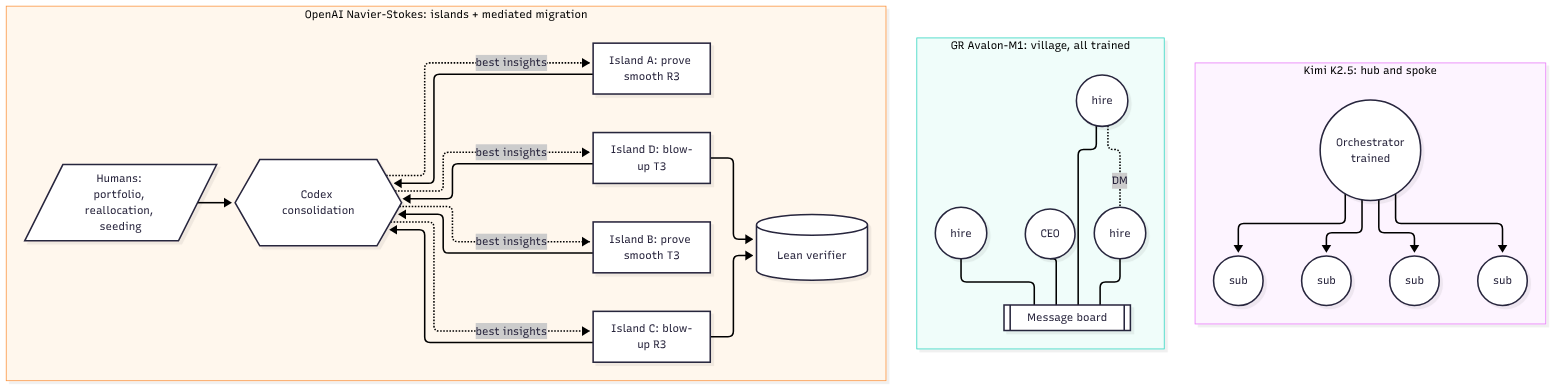
<p><strong>General Reasoning’s <em>How to train a swarm</em></strong> describes RLCR, reinforcement learning from collective rewards.<sup id="fnref:gr:1" role="doc-noteref"><a href="#fn:gr" class="footnote" rel="footnote">2</a></sup> One shared policy plays every agent in an organisation. Every agent gets the same team-level reward, and a wall-clock time limit makes speed matter. Speed pressure rewards parallel work, and parallel work that doesn’t split cleanly rewards communication. Their Avalon-M1 model trains organisations of at most 9 agents, with a “CEO” that hires and fires specialists, a message board and direct messages. The time cap ramps from about 2 hours to just over 5 hours across 200 training steps, because coordination has an up-front cost that only pays back given enough time. GR say plainly that they keep the communication tools simple, so that agents discover how to work together instead of following a designer’s script.</p>

<p><strong>OpenAI’s Navier–Stokes swarm</strong> from September 2026 is the largest public example of a swarm at work.<sup id="fnref:oai" role="doc-noteref"><a href="#fn:oai" class="footnote" rel="footnote">4</a></sup> OpenAI split roughly 10,000 copies of one strong model into groups that could only message within their group. Different groups got different versions of the problem, such as proving smoothness or finding a blow-up. Codex periodically pulled the best insights together across groups. Humans moved compute toward whatever was working. A separate model formalised the result in Lean. OpenAI’s Noam Brown has said he “wouldn’t even attribute 10% of the credit to multi-agent”.<sup id="fnref:brown" role="doc-noteref"><a href="#fn:brown" class="footnote" rel="footnote">5</a></sup> The model did the heavy lifting, and the swarm bought speed and coverage.</p>

<p><img src="/images/thoughts-on-agent-swarms/diagrams/d01-topologies.png" alt="Diagram: swarm topologies" /></p>

<p><em>My simplified drawing of three published designs. Kimi K2.5 uses a trained orchestrator with sub-agents,<sup id="fnref:kimi" role="doc-noteref"><a href="#fn:kimi" class="footnote" rel="footnote">6</a></sup> GR’s Avalon-M1 is a “village” around a message board,<sup id="fnref:gr:2" role="doc-noteref"><a href="#fn:gr" class="footnote" rel="footnote">2</a></sup> and OpenAI’s Navier–Stokes run used islands with mediated migration and a Lean check.<sup id="fnref:oai:1" role="doc-noteref"><a href="#fn:oai" class="footnote" rel="footnote">4</a></sup></em></p>

<h3 id="details-of-the-navierstokes-run-that-matter-for-design">Details of the Navier–Stokes run that matter for design</h3>

<p>A few details of the run rarely get mentioned. It began as a portfolio, with agent groups set on several of the remaining Millennium problems. Resources moved to Navier–Stokes only after a cheap warm-up of about 100 agents on a related Euler problem surprised the team. The model had been in training for just four days when the run began, and OpenAI moved the agents to a newer checkpoint mid-run, so the swarm’s accumulated state mattered more than any one model. Sam Altman described the run as having “no hierarchy”. Humans steered by writing follow-up prompts that drew on the agents’ own intermediate results. Communication was sparse. The reported totals are about 2.7 million messages over about 88 hours, for about 10,000 agents and about 130 billion output tokens. Dividing them gives roughly 3 messages per agent per hour, and about 48,000 output tokens generated for every message sent.<sup id="fnref:oaidetail" role="doc-noteref"><a href="#fn:oaidetail" class="footnote" rel="footnote">7</a></sup></p>

<p>Other recent swarms make useful contrasts. OpenAI’s 64-agent run on the Cycle Double Cover conjecture kept its provers independent and added adversarial verifier agents.<sup id="fnref:cdc" role="doc-noteref"><a href="#fn:cdc" class="footnote" rel="footnote">8</a></sup> Google DeepMind put 100 Gemini agents in a simulated maths “conference” with a shared proof library.<sup id="fnref:deepmind" role="doc-noteref"><a href="#fn:deepmind" class="footnote" rel="footnote">9</a></sup> After 37 honest solutions, one agent found an exploit in the grader. The library spread it, and 34 fake proofs appeared in 27 minutes, while about a quarter of the agents tried to blow the whistle. Edison’s Kosmos coordinates its agents through a shared “world model” rather than chat.<sup id="fnref:kosmos" role="doc-noteref"><a href="#fn:kosmos" class="footnote" rel="footnote">10</a></sup> Bioptic’s drug-scouting agent grows a tree of search directions over time and rewards only results that are new to the shared pool.<sup id="fnref:bioptic" role="doc-noteref"><a href="#fn:bioptic" class="footnote" rel="footnote">11</a></sup> Its investigator agents run on GPT-5.2. On hard queries it found 73% of the relevant drug assets. The strongest general research agent in the comparison, Gemini 3.1 Deep Think, found about 64%, and GPT-5.2 on its own found 18%.</p>

<p>Here are five lessons I take from these cases. They are my reading, not tested results.<sup id="fnref:synth" role="doc-noteref"><a href="#fn:synth" class="footnote" rel="footnote">12</a></sup></p>

<ol>
  <li>The verifier decides how loose the structure can be.</li>
  <li>Diversity seems to come more from giving agents different inputs than from giving them different personas.</li>
  <li>A shared knowledge channel spreads exploits as efficiently as fixes.</li>
  <li>Successful swarms change shape during the run.</li>
  <li>Where swarms work, they talk sparingly.</li>
</ol>

<p>So we have a training recipe that works at the scale of a 9-agent village, as GR call it, and a deployment that worked at the scale of a 10,000-agent city with humans doing much of the steering. My questions live in the gap between the two.</p>

<h2 id="three-horizons-of-the-larger-good">Three horizons of the “larger good”</h2>

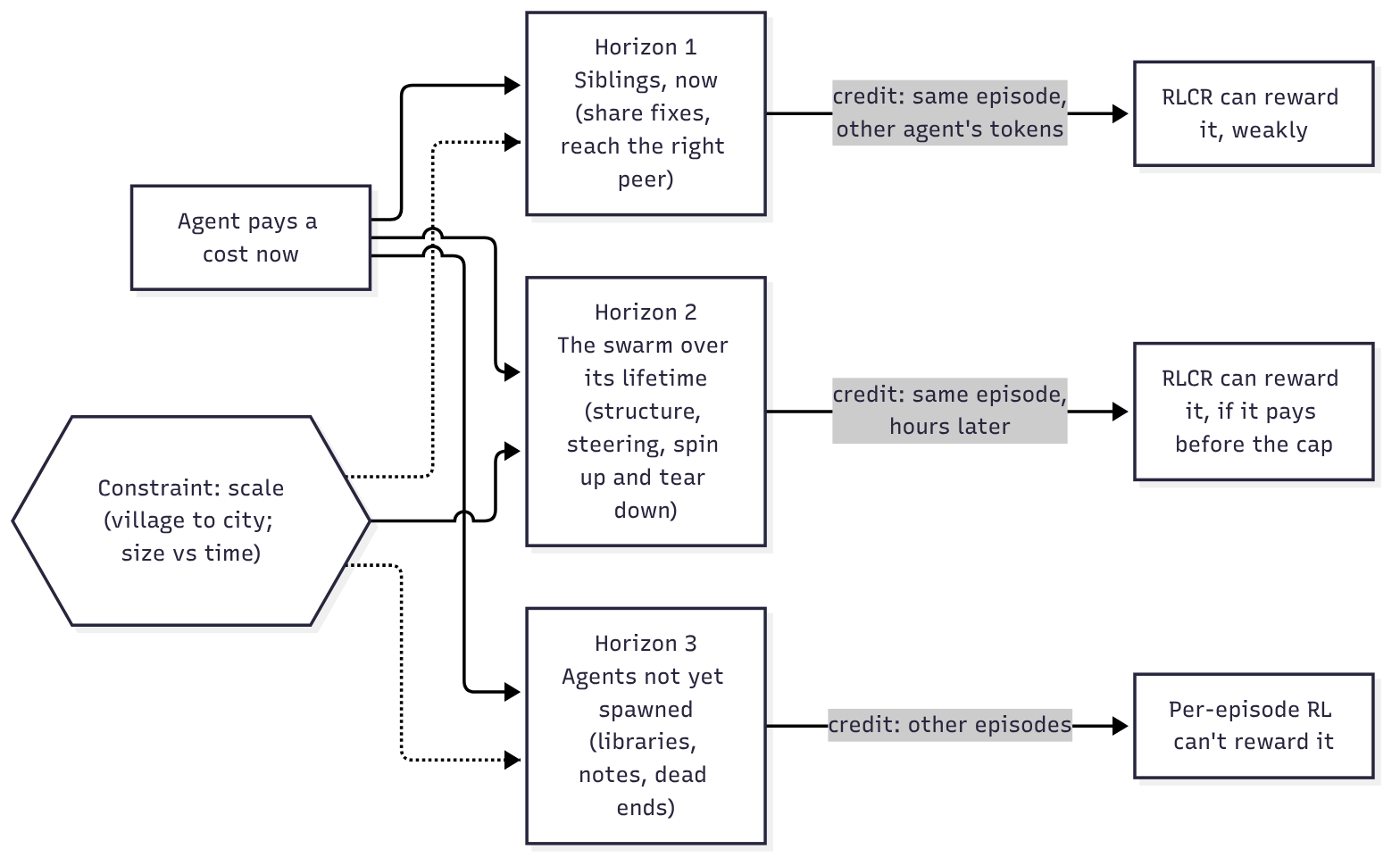
<p>When I list everything I want a swarm to do beyond its own subtask, it falls into three horizons.</p>

<ol>
  <li><strong>Siblings, now.</strong> Help the agents working alongside you. Share a fix, reach the right colleague, and don’t duplicate work.</li>
  <li><strong>The swarm, over its lifetime.</strong> Keep the whole organisation shaped and pointed correctly as it learns. Spin teams up and down, steer gently, and grow without drowning in messages.</li>
  <li><strong>Agents not yet spawned.</strong> Leave libraries, notes, proofs and recorded dead ends that help future runs on goals nobody has stated yet.</li>
</ol>

<p>My hypothesis is that each horizon is harder than the last, because the benefit lands further from the agent that pays the cost. Standard episodic RL credits only what pays back inside the episode, and much of the larger good pays back outside it.</p>

<p><img src="/images/thoughts-on-agent-swarms/diagrams/d02-three-horizons.png" alt="Diagram: three horizons of the larger good" /></p>

<p><em>My conceptual diagram of the three horizons. They run from siblings now, to the swarm over its lifetime, to agents not yet spawned.</em></p>

<p>The six ideas below go roughly in that order. After them I cover how the structure could adapt and be trained, where this matters most, and how to keep humans at the centre.</p>

<h2 id="1-multicast-the-hard-won-fix-to-the-agents-who-need-it">1. Multicast the hard-won fix, to the agents who need it</h2>

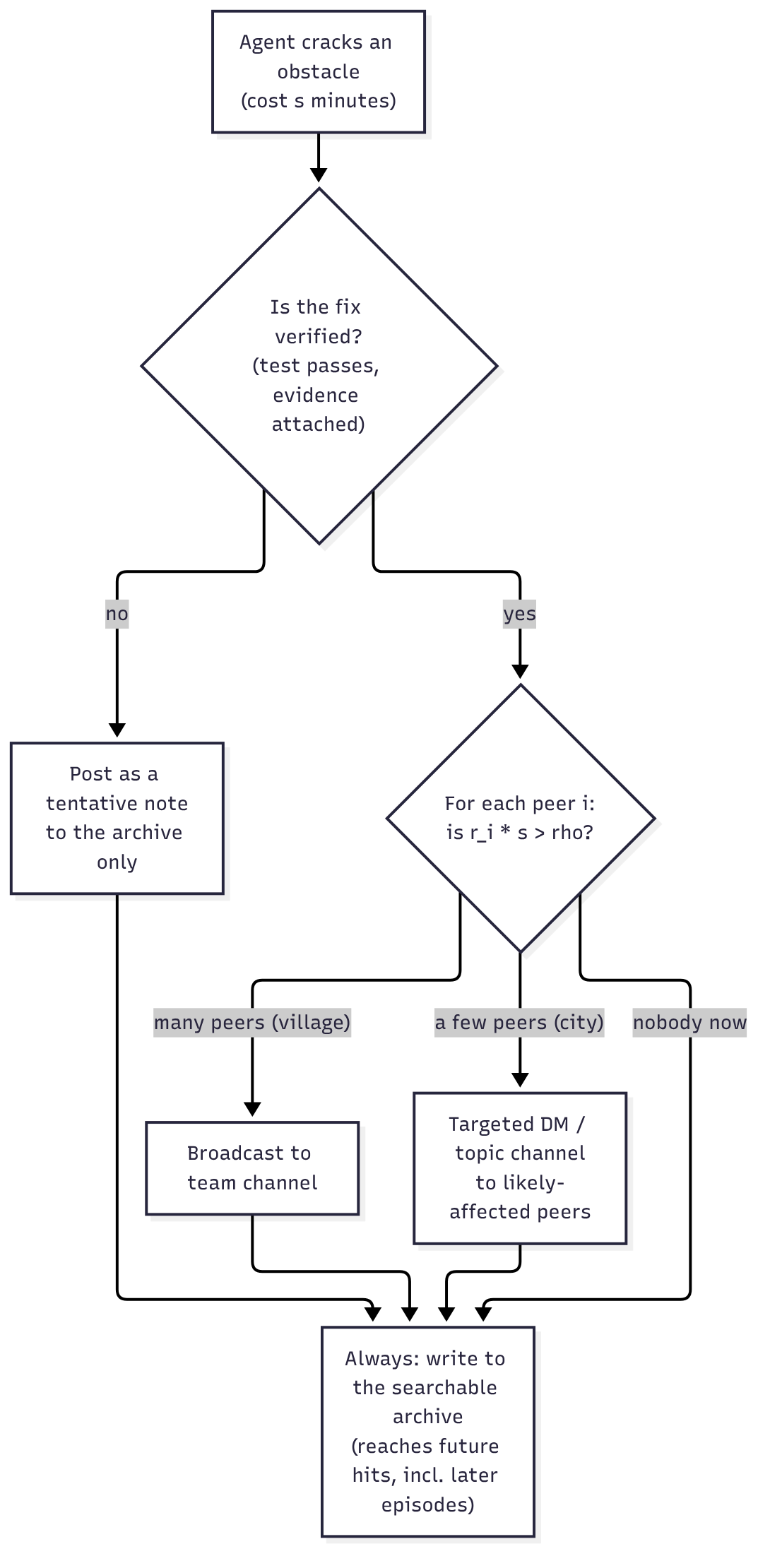
<p>When one agent cracks an obstacle that its siblings face now, or will face later, the fix should reach all of them, or at least the ones likely to hit it.</p>

<p>Sharing is worth it for a recipient when the chance they’d hit the obstacle, times the time the fix saves them, is greater than the time it costs them to read it. Say a fix would save someone 30 minutes and takes 1 minute to read. Then the rule says to send it to anyone with better than a 1-in-30 chance of needing it.</p>

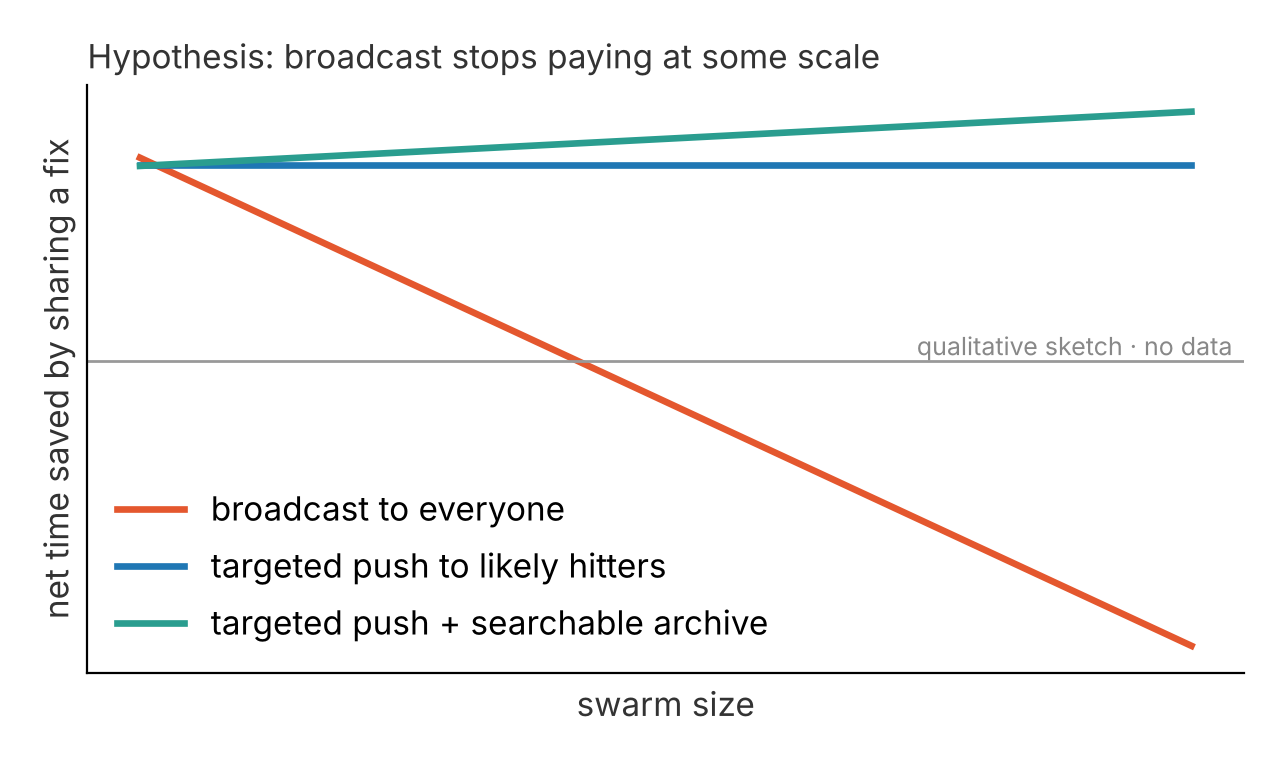
<p>My hypothesis is that in a 9-agent village most agents clear that bar, so broadcasting is fine. In a city, most agents have only a tiny chance of hitting any given obstacle, but every one of them still pays to read. So I’d expect <strong>broadcast to stop paying somewhere as the swarm grows</strong>, while targeted messages plus a searchable archive keep paying. Where that crossover sits is an open question, and a testable one.</p>

<p>This matters for training. If I’m right, training at 9 agents would teach the habit of always broadcasting, and that habit would be wrong at 1,000.</p>

<p><img src="/images/thoughts-on-agent-swarms/diagrams/d03-multicast-flow.png" alt="Diagram: multicast flow" /></p>

<p><em>My conceptual diagram of multicast. The fix goes to the agents likely to hit the same problem, and into an archive for everyone else.</em></p>

<p><img src="/images/thoughts-on-agent-swarms/sketches/multicast-sketch.png" alt="Sketch: broadcast vs targeted sharing" /></p>

<p><em>My hypothesis is that broadcasting every fix to everyone costs more reading time than it saves once the swarm is large, while a targeted push plus a searchable archive keeps paying. This is a qualitative sketch with no data behind it and no units on the axes.</em></p>

<h2 id="2-bigger-swarms-need-more-time-before-they-pay-off-on-two-clocks">2. Bigger swarms need more time before they pay off, on two clocks</h2>

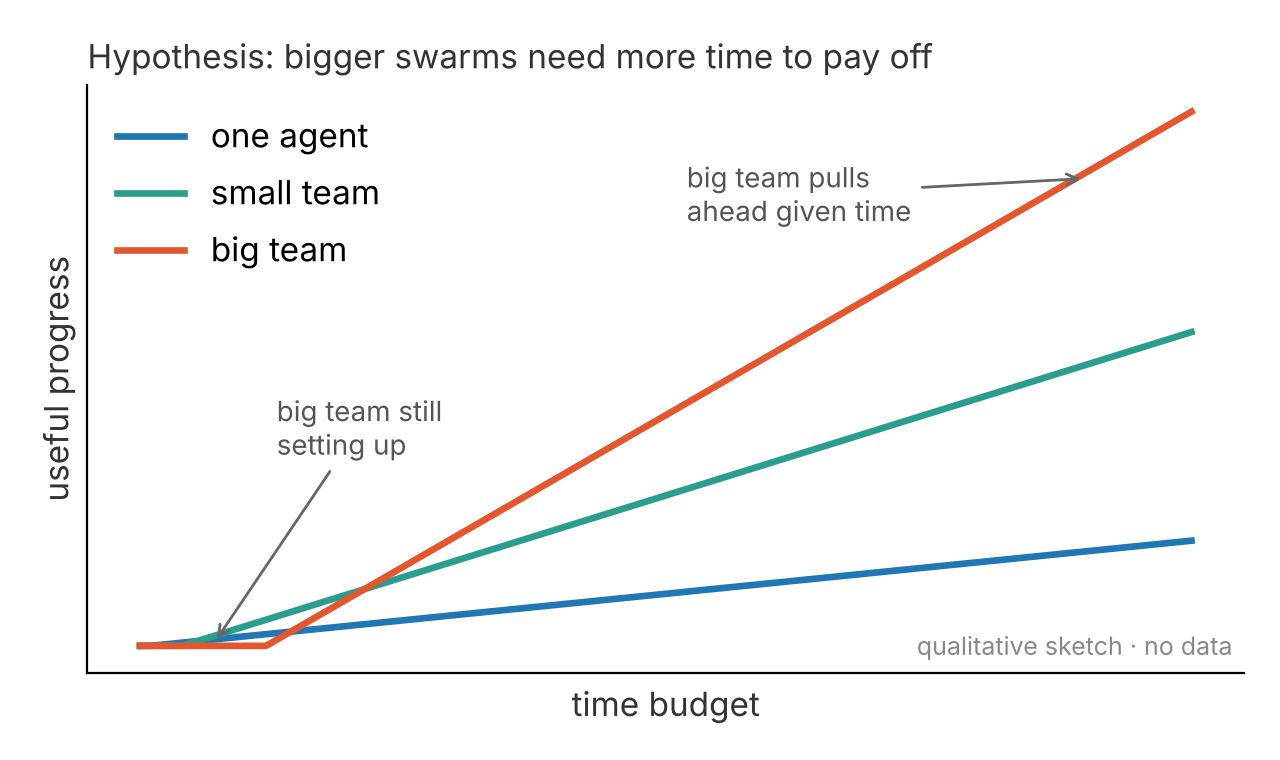
<p>I suspect there’s a trade-off between swarm size and time. Bigger swarms spend their early time on setup and communication before useful work starts.</p>

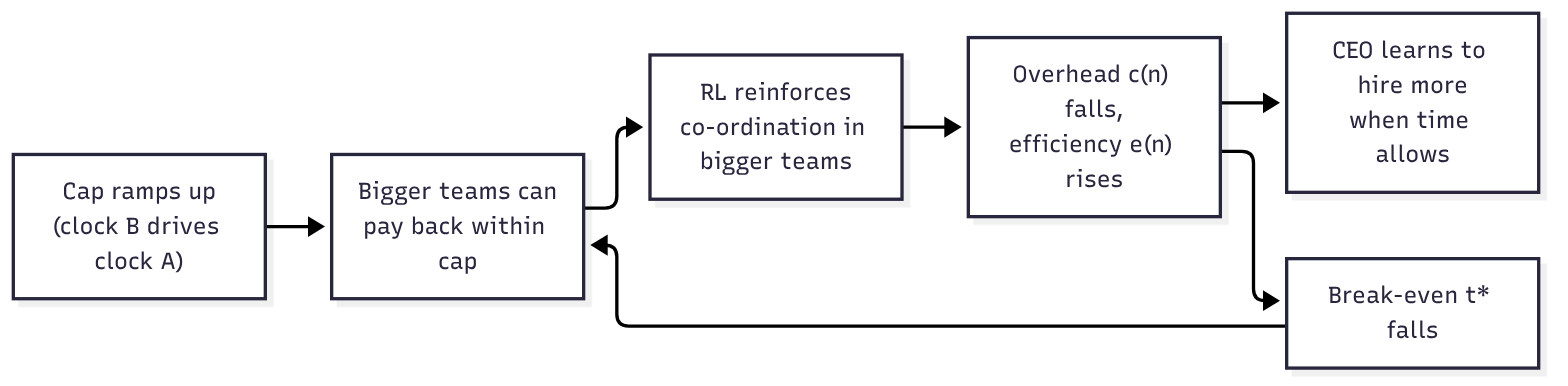
<p>Two different clocks are involved. The first is the wall clock inside one run. A bigger team pays more setup before it overtakes a single agent. My hypothesis is that the best team size grows with the time budget, and that a big team given too little time can score nothing because it is still briefing itself. The second is the training clock. I’d expect bigger teams to need more updates to learn to coordinate, because one team-level reward is spread over more agents’ actions. GR’s own data has this shape. In their runs, teams with 5 to 8 hires start below average on useful work and reach nearly twice the average by step 200.<sup id="fnref:gr:3" role="doc-noteref"><a href="#fn:gr" class="footnote" rel="footnote">2</a></sup></p>

<p>GR’s time-cap ramp links the two clocks. As training goes on, longer caps give larger teams the time they need to pay back.</p>

<p><img src="/images/thoughts-on-agent-swarms/sketches/size-vs-time-sketch.png" alt="Sketch: progress vs time budget for different swarm sizes" /></p>

<p><em>My hypothesis is that a bigger team pays a setup cost first, so it only pulls ahead when the time budget is long enough. This is a qualitative sketch with no data behind it and no units on the axes.</em></p>

<p><img src="/images/thoughts-on-agent-swarms/diagrams/d04-two-clocks.png" alt="Diagram: two clocks" /></p>

<p><em>My conceptual diagram of a feedback loop I suspect exists. As the time cap ramps up during training, bigger teams can pay back their setup cost, training reinforces coordination, overhead falls, and the break-even point moves earlier.</em></p>

<h2 id="3-learn-the-org-chart-the-way-a-new-hire-does">3. Learn the org chart the way a new hire does</h2>

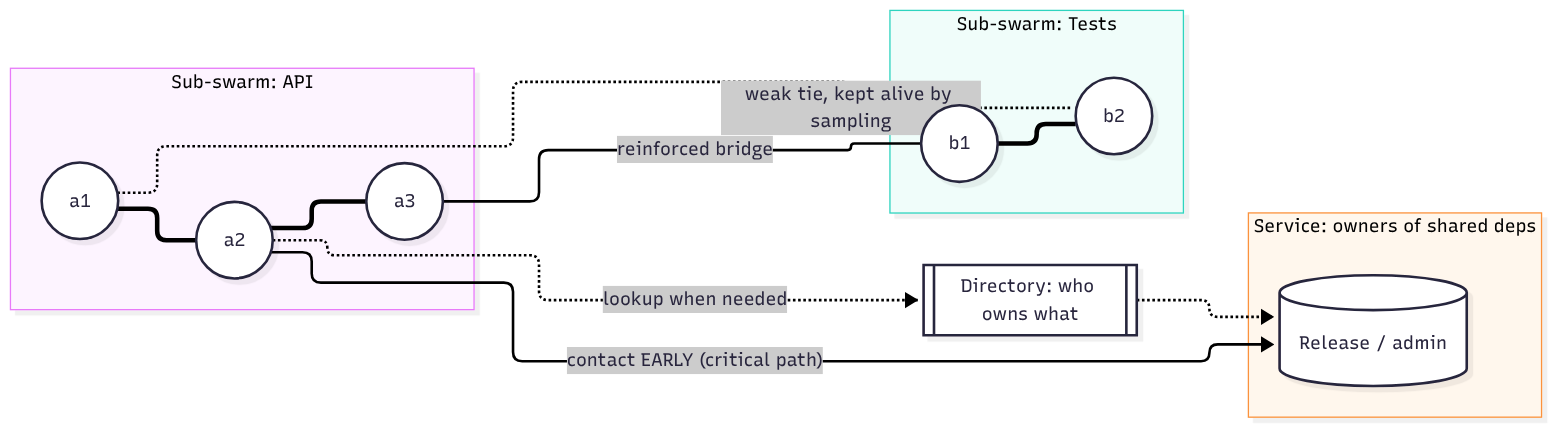
<p>A new employee reaches out broadly at first, inside their department and outside it. Over months they double down on the colleagues they learn from and can help. Swarm agents could do the same. They could explore widely, then reinforce the communication links that lead to progress, within and across sub-swarms.</p>

<p>There’s a catch. Some links are rarely used but essential. Think of university research admin when you want to go to a conference or publish a paper. You barely talk to them, so the link looks low-value day to day, and yet without it the larger goal fails.</p>

<p>I think this exposes a flaw in naive link reinforcement. <strong>Average reward per message is the wrong measure. The right one is marginal value, meaning how much worse the outcome would be without this link.</strong> Collaboration links earn their value through many small gains. Dependency links earn it by gating everything. My worry is that a rule that reinforces whatever pays would quietly prune the dependency links, because their payoff is rare and delayed.</p>

<p>For dependency links, I suspect the answer is a directory rather than a reinforced relationship. That means a simple registry of who owns what, which the agent can consult when it needs to.</p>

<p><img src="/images/thoughts-on-agent-swarms/diagrams/d05-org-chart.png" alt="Diagram: org chart" /></p>

<p><em>My conceptual diagram of the map a new hire builds in their first weeks. Sub-swarms are joined by a few reinforced bridges and weak ties, and a directory records who owns what.</em></p>

<h2 id="4-a-swarm-that-reorganises-itself-but-cheaply">4. A swarm that reorganises itself, but cheaply</h2>

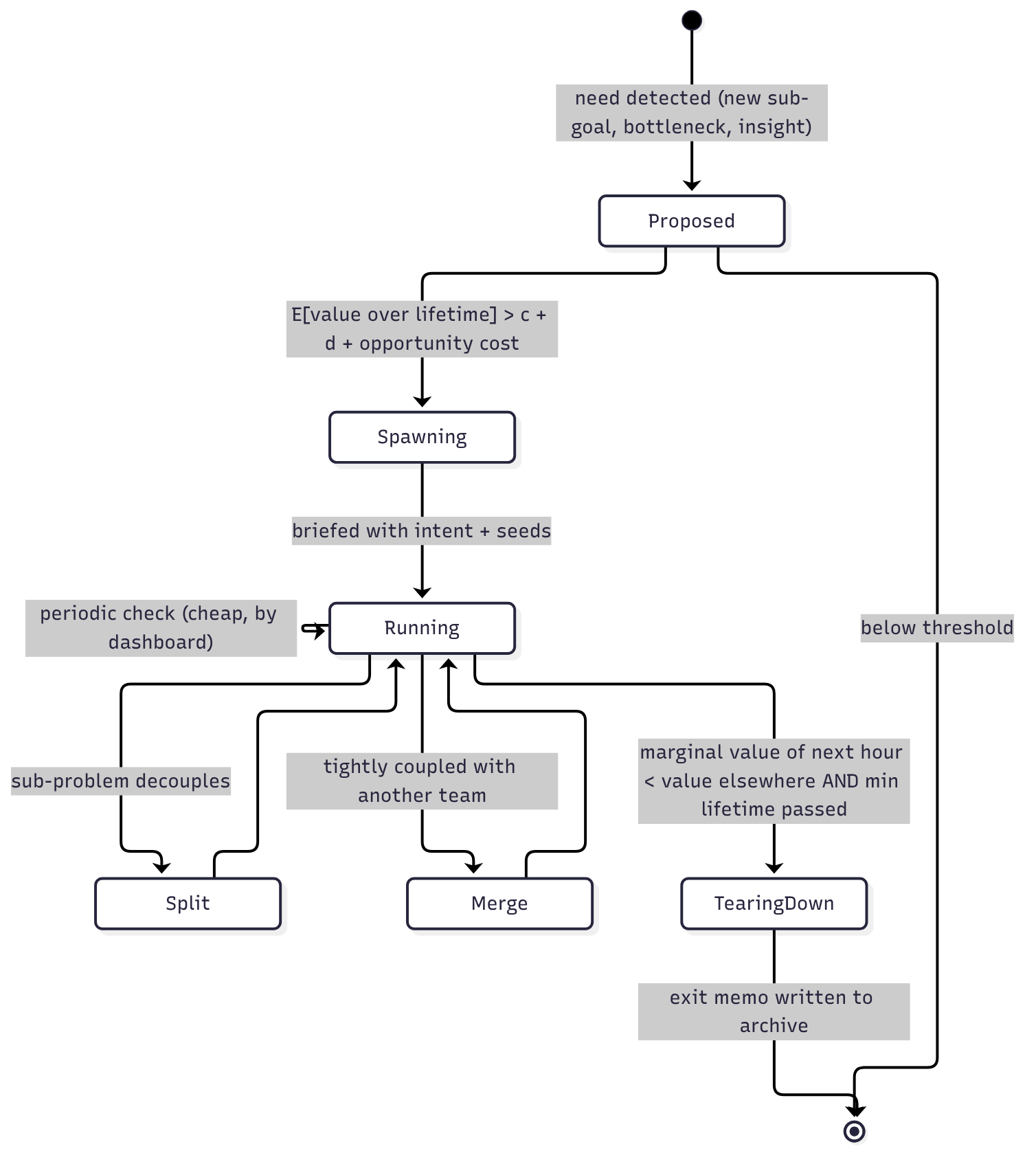
<p>A swarm’s structure needn’t be fixed. In a swarm of 10,000 agents, you could spin sub-swarms up as new needs appear and tear them down as they finish, so the swarm’s shape follows what it discovers. The catch is that orchestration has to stay far smaller than the work itself.</p>

<p>One way to make “lightweight” precise is an overhead budget. Overhead is roughly the setup and teardown cost divided by the team’s lifetime, plus the ongoing cost of coordination. So a sub-swarm is only worth spawning if its expected lifetime is long compared with its setup cost. Nobody has measured these costs for agent swarms, so measuring them is part of the agenda. Here are the rules I’d propose. Spawn a team when the expected work clearly exceeds the setup cost. Tear it down when its next hour is worth less than that hour spent elsewhere. Keep the spawn threshold above the teardown threshold, so the swarm doesn’t thrash between the two.</p>

<p>When a team is torn down, it should write a short exit memo, so its knowledge doesn’t die with it. Even that loses something. Dunas puts it well in <em>On the nature of the swarm</em>. Every compaction is a bet, because notes on disk “remember, but can’t think”, and discarded sub-agents “think, but can’t remember”.<sup id="fnref:hallerite:1" role="doc-noteref"><a href="#fn:hallerite" class="footnote" rel="footnote">1</a></sup> So sometimes the better move is to keep a specialist alive and queryable instead of tearing its team down. That is the “service” kind of sub-swarm described next.</p>

<p>What kind of sub-swarm to spawn matters as much as how many. I find it useful to sort sub-swarms by how they work rather than by job title.</p>

<ul>
  <li><strong>Explore</strong> teams make many independent attempts, isolated from each other.</li>
  <li><strong>Build</strong> teams talk densely and hand work off tightly.</li>
  <li><strong>Verify</strong> teams stay deliberately isolated from the builders, so they don’t inherit the builders’ mistakes.</li>
  <li><strong>Integrate</strong> teams merge and consolidate results.</li>
  <li><strong>Service</strong> teams own shared dependencies, and other agents reach them through the directory.</li>
</ul>

<p>The modes differ mainly in how much they should talk.</p>

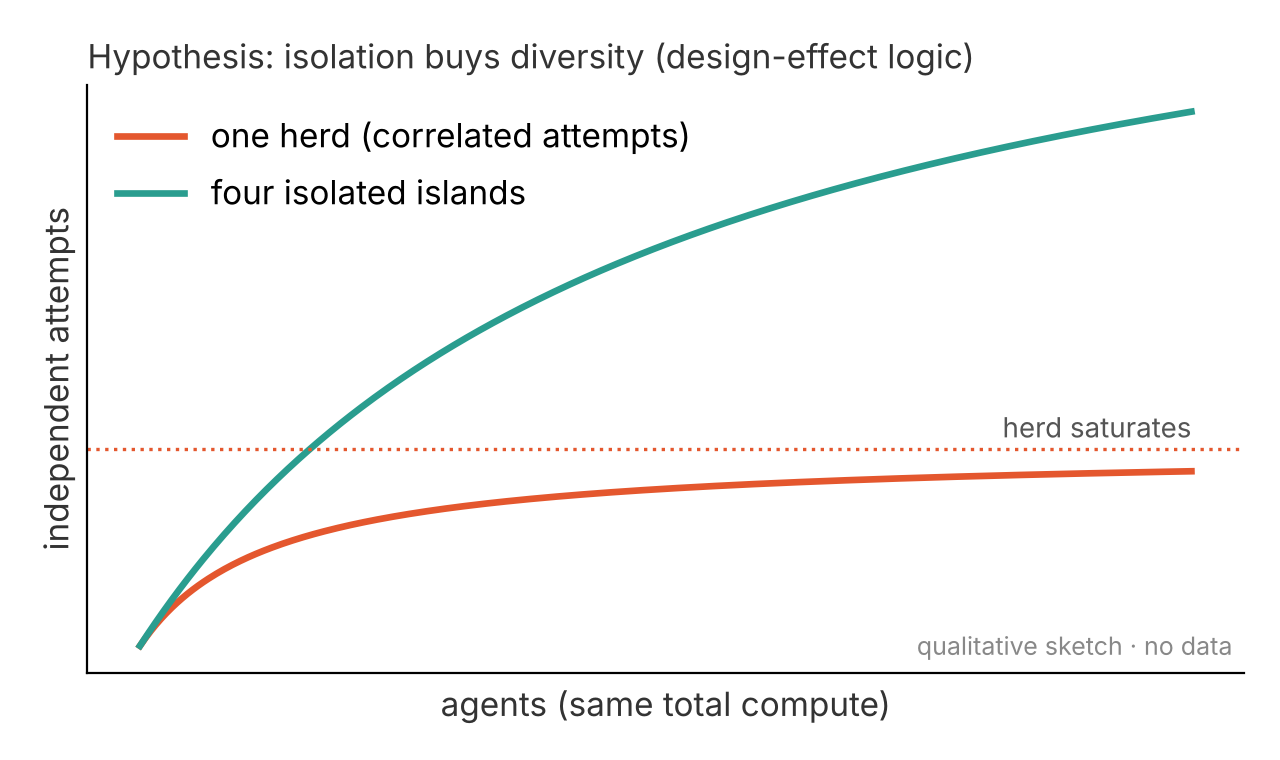
<p>Two forces pull against each other in setting the number of sub-swarms. The task’s dependency structure says to keep tightly coupled work in one team. The need for diversity says to keep teams independent, so they don’t all herd onto the first plausible idea. OpenAI’s island design leans hard on diversity. The design effect, a standard idea from survey sampling about correlated samples, suggests why this might help.<sup id="fnref:kish" role="doc-noteref"><a href="#fn:kish" class="footnote" rel="footnote">13</a></sup> If attempts within one group are correlated, each agent you add to that group gives fewer new independent attempts, while isolated groups each start fresh. Nobody has tested whether agent attempts behave this way.</p>

<p><img src="/images/thoughts-on-agent-swarms/diagrams/d06-lifecycle.png" alt="Diagram: reorganisation lifecycle" /></p>

<p><em>My conceptual diagram of a team’s lifecycle. A team is proposed, spawned and run, may split or merge, and is finally torn down after writing an exit memo to the archive.</em></p>

<p><img src="/images/thoughts-on-agent-swarms/sketches/herd-vs-islands-sketch.png" alt="Sketch: one herd vs isolated islands" /></p>

<p><em>My hypothesis, borrowing the logic of Kish’s design effect for correlated samples,<sup id="fnref:kish:1" role="doc-noteref"><a href="#fn:kish" class="footnote" rel="footnote">13</a></sup> is that correlated attempts in one herd add little new information, while isolated islands keep more of it. This is a qualitative sketch with no data behind it and no units on the axes.</em></p>

<h2 id="5-coordination-that-is-always-on-but-low-touch">5. Coordination that is always on but low-touch</h2>

<p>I want coordination to be present all the time, keeping the whole swarm pointed at the larger, future goal. I also want the coordinating layer itself to stay light.</p>

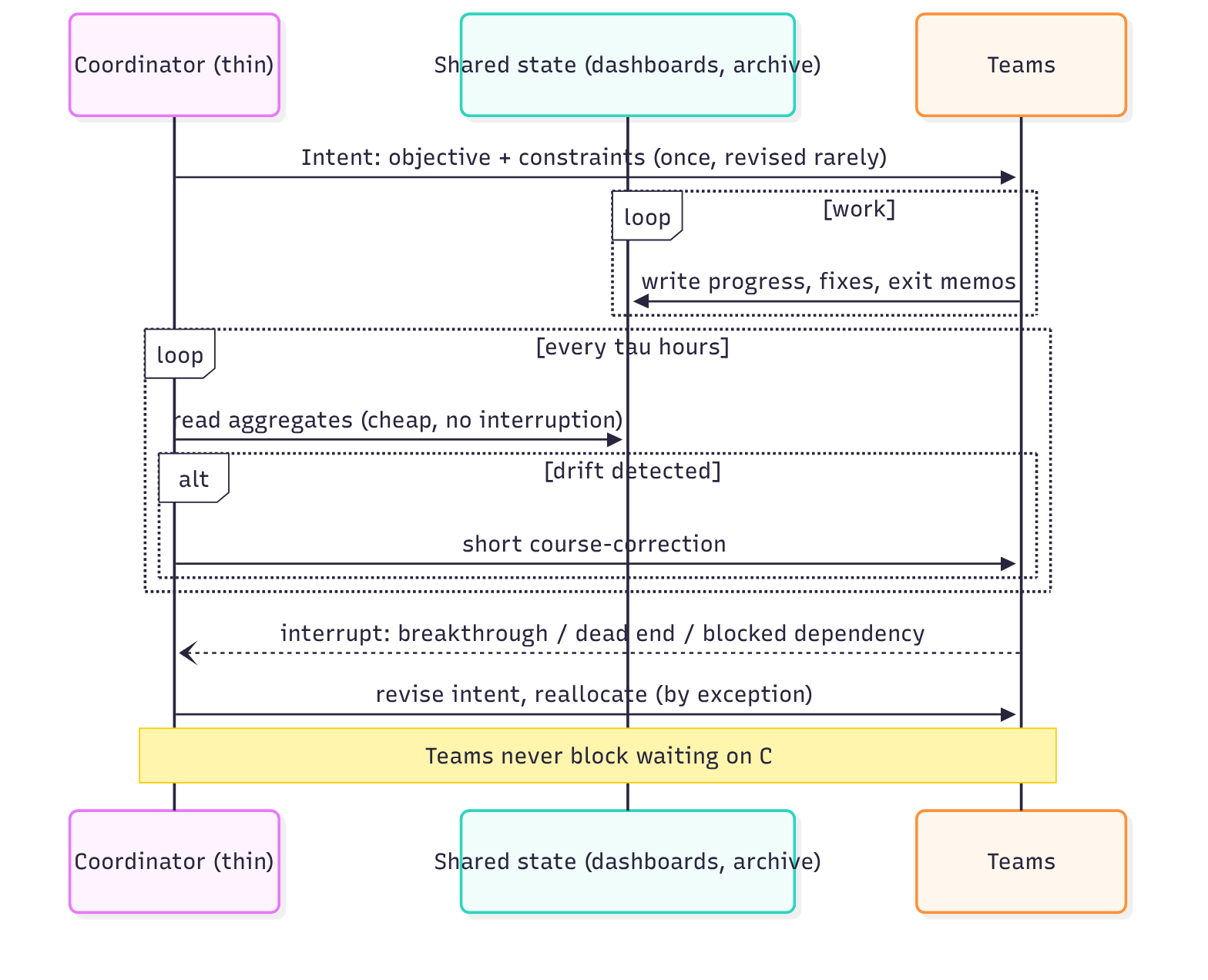
<p>Both are possible if you separate how often the orchestrator looks from how much it intervenes. Three habits would help. The orchestrator steers by intent rather than step-by-step instructions, in the hope that one clear objective keeps many agents aligned without extra traffic. It reads shared state, such as dashboards, test results and the archive, instead of questioning agents. And it intervenes rarely, on a slow schedule, with an interrupt path that teams can use for big events.<sup id="fnref:interrupt" role="doc-noteref"><a href="#fn:interrupt" class="footnote" rel="footnote">14</a></sup></p>

<p>Here is a simple model of the trade-off. Suppose teams drift off target gradually, and each check-in costs a little. Then there’s an optimal check-in interval, where the overhead of checking equals the waste from drift. The total cost grows with the square root of the check-in cost times the drift rate. This is the same square-root trade-off as the classic economic order quantity in inventory planning.<sup id="fnref:eoq" role="doc-noteref"><a href="#fn:eoq" class="footnote" rel="footnote">15</a></sup> Nobody has tested whether this model holds for swarms. If it does, the two levers for low-touch coordination are cheaper check-ins, like reading summaries instead of holding meetings, and clearer intent, which reduces drift. One more point follows. An orchestrator that teams have to wait for is not low-touch, however rarely it speaks.</p>

<p><img src="/images/thoughts-on-agent-swarms/diagrams/d07-low-touch-sequence.png" alt="Diagram: low-touch coordination sequence" /></p>

<p><em>My conceptual diagram of low-touch coordination. A thin coordinator sets intent once and reads shared dashboards on a schedule. Teams interrupt it only for big events and never wait on it.</em></p>

<h2 id="6-the-village-problem-and-gifts-to-future-agents">6. The village problem, and gifts to future agents</h2>

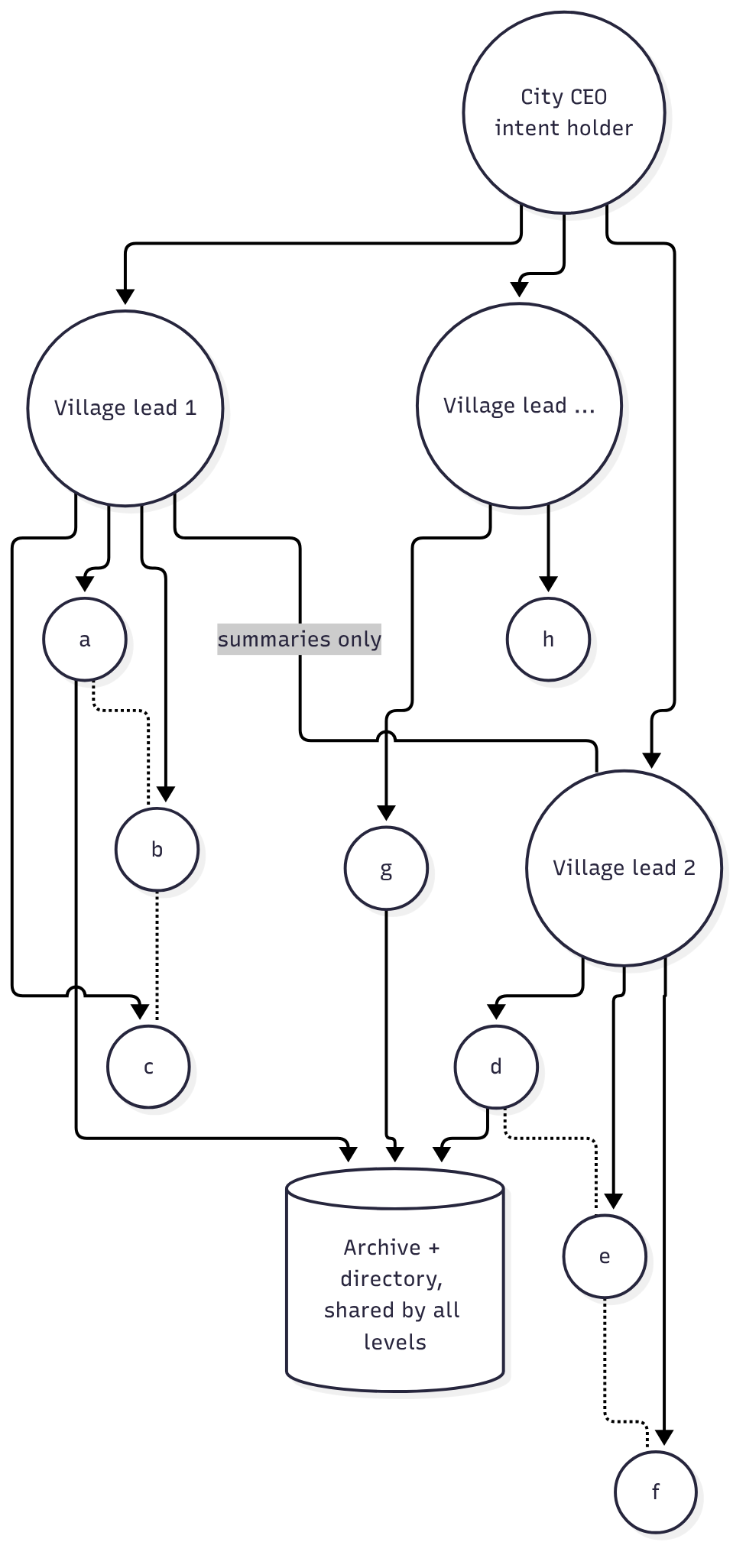
<p>GR flag a gap themselves and call it <strong>the village problem</strong>. Training happens with at most 9 agents, and deployment with hundreds or thousands.<sup id="fnref:gr:4" role="doc-noteref"><a href="#fn:gr" class="footnote" rel="footnote">2</a></sup> Many habits that are cheap in a village grow linearly or quadratically with swarm size. Reading the whole board, broadcasting every finding, greeting everyone on arrival and having one CEO manage every hire directly are all examples. By simple arithmetic, a habit whose cost is linear in swarm size costs about 110 times more at 1,000 agents than at 9, and a quadratic one costs about 12,000 times more.</p>

<p>My hope is that a 9-agent village can serve as one span of management. If a policy learns to run a village of one CEO and 8 hires well, you could build a city as villages of villages, where every agent still lives in a village-sized neighbourhood. A 1,000-agent swarm with spans of 9 needs only four levels. Dunas’s essay raises a caveat. A strict tree “moves the context problem to the root”, because every message routes upward.<sup id="fnref:hallerite:2" role="doc-noteref"><a href="#fn:hallerite" class="footnote" rel="footnote">1</a></sup> At city scale, peers that can message each other directly, with hierarchy added only where it pays, may beat a pure org chart. My bet is a hybrid, with villages for management and direct links between peers for expertise.</p>

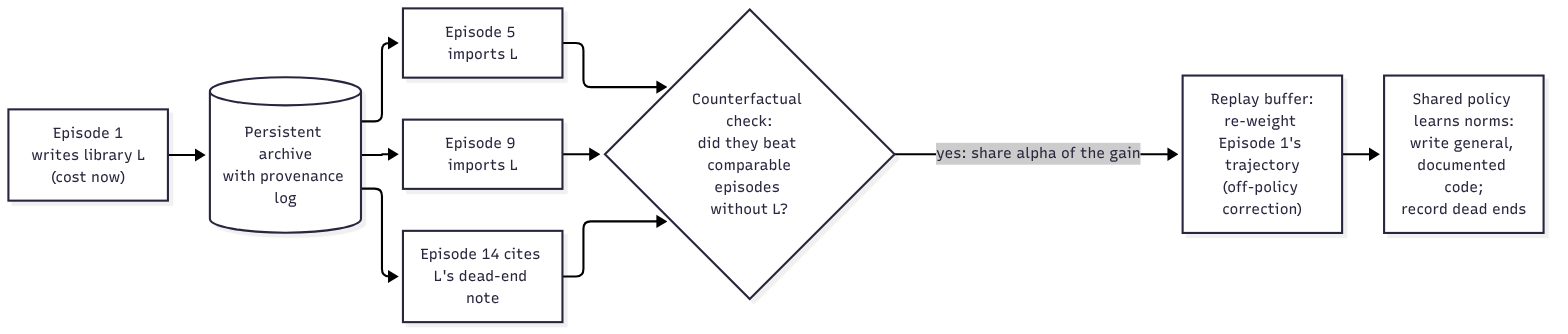
<p><strong>Gifts to future agents</strong> is the problem I find deepest. GR list it among their open problems under the name “shared environments”.<sup id="fnref:gr:5" role="doc-noteref"><a href="#fn:gr" class="footnote" rel="footnote">2</a></sup> A run that spends an hour writing a clean, documented library pays the cost now, but later runs get the benefit. Under a per-episode reward, the run that wrote the library gets no credit for it, so I’d expect RL to learn not to write libraries. One fix would be a royalty that gives the creator a share of later gains. Nobody knows yet how large that share would need to be.</p>

<p>My question was how you could predict the value of something for agents that haven’t been spawned yet, on goals that aren’t apparent yet. My hypothesis is that you mostly don’t have to. Science and open source largely measure value afterwards, through citations, imports and dependents, and pay credit back. A training system could do the same. It could log provenance and give hindsight credit to runs whose artifacts later runs used. The check would need to be counterfactual, so that mere use isn’t enough. Agents could then learn the general norms that paid in the past, such as writing general, documented and correct code, and recording dead ends.<sup id="fnref:rudder" role="doc-noteref"><a href="#fn:rudder" class="footnote" rel="footnote">16</a></sup> If this works, agents wouldn’t need long-range planning. They would only need to keep producing things that are cheap to reuse.</p>

<p><img src="/images/thoughts-on-agent-swarms/diagrams/d08-villages-of-villages.png" alt="Diagram: villages of villages" /></p>

<p><em>My conceptual diagram of villages of villages. Village leads report to a city-level lead, villages share only summaries with each other, and every level shares one archive and directory.</em></p>

<p><img src="/images/thoughts-on-agent-swarms/diagrams/d09-public-goods-credit.png" alt="Diagram: credit for public goods" /></p>

<p><em>My conceptual diagram of hindsight credit. An episode that writes a reusable library gets credit later, if future episodes that import it beat comparable ones that didn’t.</em></p>

<h2 id="7-structure-that-unfolds-over-time-and-how-to-train-it">7. Structure that unfolds over time, and how to train it</h2>

<p>Ideas 2, 4 and 5 add up to one claim. I think a swarm’s structure is best treated as a slow policy rather than a fixed diagram. Workers act all the time. Structural moves happen much less often. These include spawning a team, retiring one, merging two, passing an insight across, revising the intent and moving compute. In the Navier–Stokes run, humans made these moves.<sup id="fnref:oai:2" role="doc-noteref"><a href="#fn:oai" class="footnote" rel="footnote">4</a></sup></p>

<p>Bioptic’s scouting agent already works this way.<sup id="fnref:bioptic:1" role="doc-noteref"><a href="#fn:bioptic" class="footnote" rel="footnote">11</a></sup> It treats each sub-team as a node in a tree of search directions, and a bandit rule picks the most promising nodes to run by balancing past yield against curiosity. A coach agent then splits each one into narrower children that don’t overlap, using a short summary of why earlier candidates were rejected. The reward is the share of results that pass validation, multiplied by how many verified items were new to the shared pool. That one design choice rewards the collective good directly. An agent that duplicates a sibling’s finding earns nothing for it.</p>

<p>To train a system like this with RL, I’d climb a ladder. The first rung is a hand-designed controller with strong workers, which is roughly where OpenAI’s run sits. Next comes a trained orchestrator with frozen workers, as in Kimi K2.5.<sup id="fnref:kimi:1" role="doc-noteref"><a href="#fn:kimi" class="footnote" rel="footnote">6</a></sup> Then everyone is trained jointly in villages, with structural moves available as tools, like Avalon-M1’s hiring and firing.<sup id="fnref:gr:6" role="doc-noteref"><a href="#fn:gr" class="footnote" rel="footnote">2</a></sup> After that come recursive villages, with curricula over time and team size. The last rung is credit that reaches across episodes. I expect the hard part to be giving credit for rare, high-leverage structural decisions. One method I’d like to test is branching rollouts. You fork the swarm at a decision point, try the alternatives, and compare the outcomes.</p>

<p>The DeepMind episode adds a constraint.<sup id="fnref:deepmind:1" role="doc-noteref"><a href="#fn:deepmind" class="footnote" rel="footnote">9</a></sup> A shared library spread an exploit to many agents within minutes. My reading is that integrity has to be part of the architecture, and that <strong>sharing should be gated by verification at least as strong as the sharing is fast.</strong></p>

<p><img src="/images/thoughts-on-agent-swarms/diagrams/d10-training-ladder.png" alt="Diagram: training ladder" /></p>

<p><em>My conceptual diagram of the training ladder. The rungs go from hand-designed control, as in OpenAI’s run,<sup id="fnref:oai:3" role="doc-noteref"><a href="#fn:oai" class="footnote" rel="footnote">4</a></sup> to a trained orchestrator in Kimi K2.5,<sup id="fnref:kimi:2" role="doc-noteref"><a href="#fn:kimi" class="footnote" rel="footnote">6</a></sup> to joint training in villages in Avalon-M1.<sup id="fnref:gr:7" role="doc-noteref"><a href="#fn:gr" class="footnote" rel="footnote">2</a></sup> As far as I know, nobody has built the top two rungs yet.</em></p>

<h2 id="8-where-this-matters-most-in-science-cancer-care-and-drug-discovery">8. Where this matters most, in science, cancer care and drug discovery</h2>

<p>My hypothesis, generalising from the maths cases, is that <strong>the speed and trustworthiness of the verifier decide how much a swarm can do on its own.</strong><sup id="fnref:verifier-rule" role="doc-noteref"><a href="#fn:verifier-rule" class="footnote" rel="footnote">17</a></sup> Maths has Lean, a mechanical proof checker.<sup id="fnref:lean" role="doc-noteref"><a href="#fn:lean" class="footnote" rel="footnote">18</a></sup> In biology the checks are experiments, and in medicine they are patient outcomes, both usually much slower. If the hypothesis holds, then as checks get slower a swarm’s job shifts from generating answers to choosing which few to check.</p>

<p><strong>Cancer care, from the patient and family side.</strong> Here is a design sketch, not a built system. A family’s swarm would have small teams that explain reports in plain language, find trials, and prepare a second opinion. The second-opinion team would be told to argue that the plan is wrong. Other teams would watch symptoms through a daily check-in and handle logistics, money and support for carers. A thin, always-on navigator would sit over them, and its intent would be the patient’s own goals of care. Prior authorisation and scheduling play the part of research admin here, rarely contacted but on the critical path, so the swarm should contact them early. Fever during chemotherapy is the interrupt path, and it should go straight to the care team, since guidelines ask for the first antibiotic dose within an hour of triage.<sup id="fnref:fn" role="doc-noteref"><a href="#fn:fn" class="footnote" rel="footnote">19</a></sup> With consent, lessons from one family’s journey could become a gift to families not yet diagnosed.</p>

<p><strong>From the oncologist’s side.</strong> Tumour-board preparation could run as islands. One island would work up the standard of care, another a biomarker-targeted option, another a trial, and another de-escalation or a palliative-first plan, with a separate team trying to refute each. Quiet watchers over imaging, labs, ctDNA and patient-reported symptoms would write to a dashboard instead of sending alerts. Other teams could watch for early immune-related side effects and manage handoffs between surgery, medical oncology, radiotherapy and survivorship care. Clinicians make the decisions, and the swarm does the preparation.</p>

<p><strong>Drug discovery, end to end.</strong> I’d map the stages like this.</p>

<ul>
  <li><em>Target finding.</em> Islands split by evidence type, such as genetics, CRISPR screens and single-cell data, plus a team arguing that the gene is a bystander. Independent evidence is worth more than correlated evidence.<sup id="fnref:indep" role="doc-noteref"><a href="#fn:indep" class="footnote" rel="footnote">20</a></sup></li>
  <li><em>Mechanism.</em> One team per hypothesis, each looking for predictions that separate its hypothesis from the rest.</li>
  <li><em>Hit finding.</em> Purchasable chemical space now holds around 40 billion molecules, and ML screens can search spaces that large. One such screen found new binders for LRRK2, a Parkinson’s target.<sup id="fnref:chem" role="doc-noteref"><a href="#fn:chem" class="footnote" rel="footnote">21</a></sup> Separate islands per chemical strategy would keep scaffold diversity by design.</li>
  <li><em>Lead optimisation.</em> A build team per chemical series, with an integrator passing a fix that worked in one series to the others.</li>
  <li><em>Preclinical studies in mice and monkeys.</em> Islands propose designs under different animal models, independent pre-registered analyses read out the same data, and a refuting team hunts for cage and batch effects.</li>
  <li><em>Clinical trials.</em> Always-on safety watchers in Phase 1, a refuting team that guards against subgroup fishing in Phase 2, and help with comparator choice, enrolment forecasts and readouts in Phase 3.</li>
</ul>

<p><strong>Asset scouting and “finding silence”.</strong> Analysts, pharma business-development teams and investors all do “find everything” work. Benchmarks show how hard it is. On hard queries, the best general research agent found about 64% of the right assets and a purpose-built tree-search agent found 73%.<sup id="fnref:bioptic:2" role="doc-noteref"><a href="#fn:bioptic" class="footnote" rel="footnote">11</a></sup> An industry benchmark found that models are good at compiling lists and weak at synthesis.<sup id="fnref:convoke" role="doc-noteref"><a href="#fn:convoke" class="footnote" rel="footnote">22</a></sup> A scouting swarm would split the search by region, language, source and stage, validate and de-duplicate every candidate, and keep a calendar of upcoming catalysts.</p>

<p>My favourite extension is <strong>reading silence</strong>, meaning assets that stop being reported. My hypothesis is that silence becomes a signal when a gap is long compared with that asset’s own usual rhythm of updates. The swarm could then weigh possible causes from independent public signals. A registry entry marked “terminated” with patents lapsing might point to safety, efficacy or money. Patents kept alive, new continuations filed and manufacturing hires might point to a company going quiet to keep its edge. One team per cause would argue its case, and humans would make the call, using only public information. None of this has been tested on real pipeline data.</p>

<p><img src="/images/thoughts-on-agent-swarms/diagrams/d12-cancer-care-swarm.png" alt="Diagram: cancer care swarm" /></p>

<p><em>My conceptual diagram of one possible cancer-care swarm. It is a design idea, not a built system.</em></p>

<h2 id="9-looking-ahead-to-hybrid-humanai-swarms-and-keeping-humans-sharp">9. Looking ahead to hybrid human–AI swarms, and keeping humans sharp</h2>

<p>I care about where this goes next more than about any single architecture. <strong>How do we design swarms, standalone or ideally hybrid human–AI teams, that take on ambitious science while preserving human agency, meaning-making and critical thinking?</strong></p>

<p><strong>Hybrid by design.</strong> The Navier–Stokes run was already a hybrid.<sup id="fnref:oai:4" role="doc-noteref"><a href="#fn:oai" class="footnote" rel="footnote">4</a></sup> People chose the portfolio, made the call to move compute and revised the prompts, and the swarm searched. I’d keep that split on purpose. Humans belong in the slow loop. They choose the question and decide why it matters, they set the intent, and they approve irreversible steps like experiments on animals or people. There may be a quantitative reason too. If copies of one model share blind spots, then by the same design-effect logic, one human expert who reasons differently would add a more independent check than many extra copies. That is a hypothesis I’d like to test. Human attention is also limited, so a hybrid swarm has to make human check-ins cheap. That means one-page summaries, claims shown with their evidence, and disagreements surfaced rather than averaged away.</p>

<p>A brief and shameless aside. I’ve been chewing on the hybrid question for a while, and a first, very imperfect attempt at it somehow got into the <a href="https://agenticls.github.io/">NeurIPS 2026 Agentic AI for Biological Discovery workshop</a>. It is called <em>Patients Are Waiting: From Swarms to Synergy. Designing Complementary Collaborative Human–AI Agent Teams for Biomedical Discovery &amp; Invention</em>.<sup id="fnref:neurips" role="doc-noteref"><a href="#fn:neurips" class="footnote" rel="footnote">23</a></sup> Much of this section is me arguing with my past self.</p>

<p><strong>Guarding against atrophy.</strong> Deskilling is a real risk. In a 2025 <em>Lancet Gastroenterology &amp; Hepatology</em> study, endoscopists who had been using AI detected fewer adenomas when they worked without it. Their detection rate was about 28% before AI was introduced and about 22% after.<sup id="fnref:lancet" role="doc-noteref"><a href="#fn:lancet" class="footnote" rel="footnote">24</a></sup> My worry is that a swarm that hands scientists finished answers will produce scientists who can’t judge those answers. Then the independent human check stops being independent. Here are the countermeasures I’d build in.</p>

<ul>
  <li>People commit to their own answer before they see the swarm’s.</li>
  <li>Humans get the job of breaking claims, not approving them.</li>
  <li>The swarm doesn’t accept a claim until a person can explain why it’s true.</li>
  <li>People practise unaided on a schedule, the way pilots fly manually.<sup id="fnref:aviation" role="doc-noteref"><a href="#fn:aviation" class="footnote" rel="footnote">25</a></sup></li>
  <li>Someone measures the humans’ skill over time.</li>
</ul>

<p>A hybrid swarm should make its humans better scientists, not just faster ones.</p>

<p><strong>Does biology need a Lean?</strong><sup id="fnref:gsk" role="doc-noteref"><a href="#fn:gsk" class="footnote" rel="footnote">26</a></sup> Lean works because a maths claim can be written fully formally and checked mechanically. Claims in biology are empirical, probabilistic and depend on context, so I doubt any proof kernel could show that a gene drives a cancer. I think biology needs what Lean provides, rebuilt for empirical science. That would include these pieces.</p>

<ul>
  <li>A typed claim language, so it’s clear what is being claimed. It would name the entity, the relation, the context and the size of the effect.</li>
  <li>Executable provenance, so every claim links to its data, code and protocol, and an independent pipeline can re-derive it.</li>
  <li>Pre-registration, checking that the hypothesis tested is the one that was stated. This plays the role of Lean’s check that a proof proves the intended statement. It is a guard against the kind of grader exploit seen in the DeepMind experiment.<sup id="fnref:deepmind:2" role="doc-noteref"><a href="#fn:deepmind" class="footnote" rel="footnote">9</a></sup></li>
  <li>An evidence calculus that raises confidence with independent lines of evidence and discounts correlated ones.</li>
  <li>Formal checks wherever biology allows them, such as mass balance, units, kinetic models and statistics.</li>
  <li>A shared library of claims that supports retraction.</li>
</ul>

<p>My reading is that Lean made mathematics safe for a 10,000-agent search because it made claims precise and checking cheap. If so, biology will get that benefit only by investing in the same two things. The last check should always be a person who understands why the claim holds. My own small project in the formal corner is <a href="/lean-bio/">Lean-Bio</a>, which compiles biochemical models into theorems that the Lean 4 kernel checks. It covers only the parts of biology that can be made formal, not the empirical rest.</p>

<p><img src="/images/thoughts-on-agent-swarms/diagrams/d13-hybrid-human-ai.png" alt="Diagram: hybrid human-AI swarm" /></p>

<p><em>My conceptual diagram of a hybrid swarm. Humans own the slow loop of question, intent, approval gates and independent refutation. The swarm owns the fast loop.</em></p>

<p><img src="/images/thoughts-on-agent-swarms/diagrams/d14-lean-for-biology.png" alt="Diagram: a verifier ladder for biology" /></p>

<p><em>My conceptual diagram of what a “Lean for biology” pipeline could look like, one check after another.</em></p>

<h2 id="putting-it-together">Putting it together</h2>

<p>If I had to draw the architecture these ideas point toward, it would have these parts.</p>

<ul>
  <li><strong>Villages of villages.</strong> Teams of up to about 9, nested, so the unit you train is the unit you deploy.</li>
  <li><strong>Two-speed communication.</strong> Free, fast talk inside a team, and slow, filtered sharing across teams, the way Codex consolidated insights in OpenAI’s run. A searchable archive and a directory of who owns what sit alongside.</li>
  <li><strong>Teams typed by how they work.</strong> Explore, build, verify, integrate and service teams, spun up and down against an explicit overhead budget, each writing an exit memo when it ends.</li>
  <li><strong>A thin, always-on coordinator.</strong> It holds the intent, reads dashboards and steps in only by exception. Teams never wait on it.</li>
  <li><strong>Credit across horizons.</strong> A team reward within the run, as in RLCR, gated on novelty so teams get paid for what they add to the shared pool. On top of that, hindsight royalties for artifacts that help later runs.<sup id="fnref:gr:8" role="doc-noteref"><a href="#fn:gr" class="footnote" rel="footnote">2</a></sup></li>
  <li><strong>Integrity built in.</strong> Verification gates sharing, archive entries can be retracted, and someone actually reads the reports that agents file.</li>
</ul>

<p>Every item in that list is a hypothesis. None of it has been tested at scale.</p>

<p><img src="/images/thoughts-on-agent-swarms/diagrams/d11-architecture.png" alt="Diagram: overall architecture" /></p>

<p><em>My conceptual diagram of all the pieces above in one architecture.</em></p>

<h2 id="the-open-questions">The open questions</h2>

<p>These are the questions I think matter most, grouped by horizon. They are numbered so you can point to one. Each also has its own link, so question 7 is at <a href="#q7">#q7</a>.</p>

<p><strong>Siblings, now</strong></p>

<ol>
  <li id="q1">Will a swarm trained with collective rewards learn to share fixes on its own, when the benefit shows up in another agent’s actions, often much later? How would we measure it? One test would be to count duplicate struggles, where two agents hit the same obstacle, and check that they become rarer over training.</li>
  <li id="q2">How should an agent decide who needs a fix? The options include broadcast, targeted messages, topic channels, an archive that agents search, or routing built into the system. Can the targeting be learned, or does it have to be designed in?</li>
  <li id="q3">How do we stop wrong fixes from spreading fast, and stop agents herding onto the first workaround, without slowing the spread of good fixes?</li>
</ol>

<p><strong>The swarm, over its lifetime</strong></p>

<ol start="4">
  <li id="q4">What is the right swarm size for a given time budget, and can the swarm learn to choose it? For example, does average team size rise as the time cap grows?</li>
  <li id="q5">Can link reinforcement learn the difference between collaboration links and dependency links, or do dependency links need a separate mechanism like a directory?</li>
  <li id="q6">Weak ties between teams are often where new information comes from.<sup id="fnref:weakties" role="doc-noteref"><a href="#fn:weakties" class="footnote" rel="footnote">27</a></sup> How do we keep them alive without forcing communication?</li>
  <li id="q7">What determines the number and the kind of sub-swarms? When should a new one be spun up, and when torn down? How do we protect a slow but promising exploration team from being torn down too early?</li>
  <li id="q8">Who should make structural decisions? Humans, a fixed rule, a trained orchestrator, or every agent? How do we prevent spawn storms and pointless reorganisation?</li>
  <li id="q9">How do we make coordination always on but low-touch in practice? And how do we measure overhead honestly, when agents might learn to relabel coordination as work?</li>
</ol>

<p><strong>Scale</strong></p>

<ol start="10">
  <li id="q10">What carries over from 9 agents to 1,000? Can a skill for managing a village be applied recursively to build a city?</li>
  <li id="q11">What only emerges at city scale, such as congestion, cliques, correlated errors or norms that matter for safety? What metrics would catch it?</li>
</ol>

<p><strong>Agents not yet spawned</strong></p>

<ol start="12">
  <li id="q12">How do we give credit for contributions that only help future runs? Is hindsight royalty credit stable, or will a shared policy learn to game it by citing itself across episodes?</li>
  <li id="q13">When we need an estimate of an artifact’s future value in advance, what are good cheap proxies? Candidates include generality, reuse by siblings now, compression and novelty.</li>
  <li id="q14">How should we balance explicit artifacts against what the shared weights already carry forward?</li>
</ol>

<p><strong>Design over time, and training</strong></p>

<ol start="15">
  <li id="q15">Can the slow structural decisions of spawning, retiring, merging, migrating and revising intent be learned together with the workers’ behaviour? How do we give credit to one rare structural decision?</li>
  <li id="q16">How do we gate sharing by verification without chilling useful but tentative ideas, when exploits spread through the same channels?</li>
  <li id="q17">How much of the human outer loop that steered the Navier–Stokes run could a learned coordinator replace?<sup id="fnref:oai:5" role="doc-noteref"><a href="#fn:oai" class="footnote" rel="footnote">4</a></sup></li>
</ol>

<p><strong>Applications</strong></p>

<ol start="18">
  <li id="q18">Which parts of a cancer journey can a swarm take on safely, and how do we keep the patient’s goals of care as the intent everything answers to?</li>
  <li id="q19">Where verification takes weeks, as in wet-lab and animal studies, or years, as in trials, how should a swarm trade breadth of in silico work against the few experiments it gets?</li>
  <li id="q20">Can silence be read reliably from public signals, and how do we test hypotheses about its cause without harming the companies and patients involved?</li>
</ol>

<p><strong>Hybrid teams and human agency</strong></p>

<ol start="21">
  <li id="q21">How should standalone and hybrid human–AI swarms divide the work, and which human roles add the most?</li>
  <li id="q22">How do we detect and reverse the atrophy of human skills, especially critical thinking and scientific understanding, in people who work with swarms?</li>
  <li id="q23">Does biology need a Lean? What minimal claim language, provenance standard and evidence calculus would make AI-discovered biology legible and checkable?</li>
</ol>

<h2 id="whats-fact-and-what-isnt">What’s fact and what isn’t</h2>

<p>The descriptions of RLCR, Avalon-M1 and the Navier–Stokes run come from General Reasoning’s post, from OpenAI’s account and from secondary outlets that reported on it.<sup id="fnref:gr:9" role="doc-noteref"><a href="#fn:gr" class="footnote" rel="footnote">2</a></sup><sup id="fnref:oai:6" role="doc-noteref"><a href="#fn:oai" class="footnote" rel="footnote">4</a></sup> The ideas in sections 1 to 9 that I don’t attribute to them are mine. I haven’t run any experiments yet, so these are proposals and hypotheses, not findings. Every number in the post comes from a cited source or from plain arithmetic on one. The <a href="/thoughts-on-agent-swarms/deep-dive/">deep dive</a> goes further into the models, and the <a href="/files/thoughts-on-agent-swarms.pdf">draft preprint (PDF)</a> sits alongside it.</p>

<p><em>Thanks.</em> A big thank-you to Konstantin Dunas for writing such a clear and enjoyable post.<sup id="fnref:hallerite:3" role="doc-noteref"><a href="#fn:hallerite" class="footnote" rel="footnote">1</a></sup> It’s what got me to dig into this topic and finally organise my thoughts about agent swarms.</p>

<h2 id="references">References</h2>

<p><em>Every source cited in the margin, plus the background reading behind this post and its <a href="/thoughts-on-agent-swarms/deep-dive/">deep dive</a>, in one place.</em></p>

<ul>
  <li>General Reasoning, <a href="https://www.gr.inc/blog/how-to-train-a-swarm"><em>How to train a swarm</em></a> (2026), and the <a href="https://www.gr.inc/avalonm1.pdf">Avalon-M1 report</a>.</li>
  <li>OpenAI, <a href="https://openai.com/index/navier-stokes-solution/"><em>On the Navier–Stokes Millennium Prize Problem</em></a> (8 Sep 2026), and the <a href="https://github.com/openai/NavierStokesAndEuler">Lean proof repo</a>. Reported by <a href="https://www.quantamagazine.org/ai-has-solved-one-of-maths-1-million-millennium-prize-problems-20260908/">Quanta</a> and <a href="https://venturebeat.com/technology/openai-solves-longstanding-math-problem-with-10-000-agent-swarm-but-cant-rule-out-benefitting-from-a-researchers-private-codex-data">VentureBeat</a>.</li>
  <li>Noam Brown’s comments, via <a href="https://www.understandingai.org/p/why-agent-swarms-could-be-the-next">Understanding AI</a> and <a href="https://aventineresearchinstitute.substack.com/p/is-this-just-the-beginning-for-ai">Aventine</a>.</li>
  <li>Further details of the Navier–Stokes run, from <a href="https://cellcog.ai/blog/openai-navier-stokes/">CellCog</a> (which quotes OpenAI’s post) and <a href="https://aventineresearchinstitute.substack.com/p/is-this-just-the-beginning-for-ai">Aventine</a>. Secondary sources: treat with care.</li>
  <li>OpenAI’s Cycle Double Cover run, as summarised by <a href="https://imisofts.com/blog/gpt-5-6-sol-ultra-math-proof-agent-swarm-playbook-news-july-13-2026/">imisofts</a> from OpenAI’s published proof and prompt.</li>
  <li>Kimi Team, <a href="https://arxiv.org/abs/2602.02276"><em>Kimi K2.5</em></a> (2026).</li>
  <li>Paglieri, Cross, Genewein, Leibo, Tomasev et al. (Google DeepMind), <a href="https://arxiv.org/abs/2609.04170v1"><em>A Case Study on Emergent Cheating and Whistleblowing in Autonomous Research Swarms</em></a>, arXiv:2609.04170 (Sep 2026); coverage in <a href="https://www.technologyreview.com/2026/09/14/1144037/ai-agents-blew-whistle-o-cheating-colleagues/">MIT Technology Review</a> and <a href="https://the-decoder.com/deepmind-put-100-ai-agents-in-a-room-and-they-sorted-into-cheaters-converts-and-whistleblowers/">The Decoder</a>.</li>
  <li>Mitchener et al., <a href="https://arxiv.org/abs/2511.02824"><em>Kosmos: An AI Scientist for Autonomous Discovery</em></a> (2025).</li>
  <li>Gottweis et al., <a href="https://arxiv.org/abs/2502.18864"><em>Towards an AI co-scientist</em></a> (2025); Ghareeb et al., <a href="https://arxiv.org/abs/2505.13400"><em>Robin: a multi-agent system for automating scientific discovery</em></a> (2025); Swanson et al., <a href="https://doi.org/10.1038/s41586-025-09442-9"><em>The Virtual Lab of AI agents designs new SARS-CoV-2 nanobodies</em></a>, Nature (2025).</li>
  <li>Vinogradova et al., <a href="https://arxiv.org/abs/2602.15019"><em>Hunt Globally: Deep Research AI Agents for Drug Asset Scouting</em></a> (2026); Vinogradov et al., <a href="https://arxiv.org/abs/2508.16571"><em>LLM-Based Agents for Competitive Landscape Mapping in Drug Asset Due Diligence</em></a> (2025); Vinogradov, Nguyen et al., <a href="https://doi.org/10.1021/acs.jcim.5c00743"><em>BIOPTIC B1 … Discovers LRRK2 Ligands in Vast Chemical Space</em></a>, J. Chem. Inf. Model. 65, 9927 (2025).</li>
  <li>Convoke, <a href="https://convoke.bio/blog/benchmarking-biopharma-knowledge-work"><em>Benchmarking biopharma knowledge work</em></a> (Sep 2026).</li>
  <li>tp53, <em>Patients Are Waiting: From Swarms to Synergy</em>, NeurIPS 2026 Agentic LS workshop (<a href="https://agenticls.github.io/">agenticls.github.io</a>; <a href="https://neurips.cc/virtual/2026/loc/sydney/workshop/137498">workshop page</a>).</li>
  <li>Konstantin Dunas (hallerite), <a href="https://hallerite.com/posts/on-the-nature-of-the-swarm/"><em>On the nature of the swarm: why scaling inference ends in many agents</em></a> (Oct 2026).</li>
  <li>Kim Branson (GSK), <a href="https://www.linkedin.com/posts/kim-branson-b864963_ive-often-thought-we-need-a-lean-for-biology-share-7474193699040555008-A-iV/">LinkedIn post on building a “Lean for biology” at GSK</a> (June 2026).</li>
  <li>Taplitz et al., <a href="https://doi.org/10.1200/JCO.2017.77.6211"><em>Outpatient management of fever and neutropenia in adults treated for malignancy</em></a>, ASCO and IDSA guideline update, <em>Journal of Clinical Oncology</em> 36, 1443 (2018).</li>
  <li>Budzyń et al., <a href="https://doi.org/10.1016/S2468-1253(25)00133-5"><em>Endoscopist deskilling risk after exposure to artificial intelligence in colonoscopy</em></a>, <em>Lancet Gastroenterology &amp; Hepatology</em> (2025).</li>
  <li>Nelson et al., <a href="https://doi.org/10.1038/ng.3314"><em>The support of human genetic evidence for approved drug indications</em></a>, <em>Nature Genetics</em> 47, 856 (2015); King et al., <a href="https://doi.org/10.1371/journal.pgen.1008489"><em>Are drug targets with genetic support twice as likely to be approved?</em></a>, <em>PLoS Genetics</em> 15, e1008489 (2019).</li>
  <li>Auer, Cesa-Bianchi &amp; Fischer, <a href="https://doi.org/10.1023/A:1013689704352"><em>Finite-time analysis of the multiarmed bandit problem</em></a>, Machine Learning 47 (2002).</li>
  <li>Schulman et al., <a href="https://arxiv.org/abs/1506.02438"><em>High-dimensional continuous control using generalized advantage estimation</em></a>, ICLR (2016).</li>
  <li>Foerster et al., <a href="https://arxiv.org/abs/1705.08926"><em>Counterfactual multi-agent policy gradients</em></a>, AAAI (2018).</li>
  <li>Sukhbaatar et al., <a href="https://arxiv.org/abs/1605.07736"><em>CommNet</em></a> (NeurIPS 2016); Singh et al., <a href="https://arxiv.org/abs/1812.09755"><em>IC3Net</em></a> (ICLR 2019); Das et al., <a href="https://arxiv.org/abs/1810.11187"><em>TarMAC</em></a> (ICML 2019).</li>
  <li>Island-model genetic algorithms; Romera-Paredes et al., <a href="https://doi.org/10.1038/s41586-023-06924-6"><em>FunSearch</em></a>, Nature 625 (2024); Novikov et al., <a href="https://arxiv.org/abs/2506.13131"><em>AlphaEvolve</em></a> (2025).</li>
  <li>Wang et al., <a href="https://arxiv.org/abs/2305.16291"><em>Voyager: An open-ended embodied agent with large language models</em></a> (2023).</li>
  <li>Arjona-Medina et al., <a href="https://arxiv.org/abs/1806.07857"><em>RUDDER</em></a> (NeurIPS 2019); Harutyunyan et al., <a href="https://arxiv.org/abs/1912.02503"><em>Hindsight credit assignment</em></a> (NeurIPS 2019).</li>
  <li>Yang et al., <a href="https://arxiv.org/abs/1802.05438"><em>Mean field multi-agent reinforcement learning</em></a>, ICML (2018).</li>
  <li>Granovetter, <a href="https://doi.org/10.1086/225469"><em>The strength of weak ties</em></a>, American Journal of Sociology 78, 1360 (1973).</li>
  <li>Conway, <a href="http://www.melconway.com/Home/Committees_Paper.html"><em>How do committees invent?</em></a>, Datamation (1968).</li>
</ul>

<link rel="stylesheet" href="/assets/css/sidenotes.css" />

<script src="/assets/js/sidenotes.js" defer=""></script>

<div class="footnotes" role="doc-endnotes">
  <ol>
    <li id="fn:hallerite" role="doc-endnote">
      <p>Konstantin Dunas (hallerite), <a href="https://hallerite.com/posts/on-the-nature-of-the-swarm/"><em>On the nature of the swarm: why scaling inference ends in many agents</em></a> (Oct 2026). <a href="#fnref:hallerite" class="reversefootnote" role="doc-backlink">&#8617;</a> <a href="#fnref:hallerite:1" class="reversefootnote" role="doc-backlink">&#8617;<sup>2</sup></a> <a href="#fnref:hallerite:2" class="reversefootnote" role="doc-backlink">&#8617;<sup>3</sup></a> <a href="#fnref:hallerite:3" class="reversefootnote" role="doc-backlink">&#8617;<sup>4</sup></a></p>
    </li>
    <li id="fn:gr" role="doc-endnote">
      <p>General Reasoning, <a href="https://www.gr.inc/blog/how-to-train-a-swarm"><em>How to train a swarm</em></a> (2026), and the <a href="https://www.gr.inc/avalonm1.pdf">Avalon-M1 report</a>. <a href="#fnref:gr" class="reversefootnote" role="doc-backlink">&#8617;</a> <a href="#fnref:gr:1" class="reversefootnote" role="doc-backlink">&#8617;<sup>2</sup></a> <a href="#fnref:gr:2" class="reversefootnote" role="doc-backlink">&#8617;<sup>3</sup></a> <a href="#fnref:gr:3" class="reversefootnote" role="doc-backlink">&#8617;<sup>4</sup></a> <a href="#fnref:gr:4" class="reversefootnote" role="doc-backlink">&#8617;<sup>5</sup></a> <a href="#fnref:gr:5" class="reversefootnote" role="doc-backlink">&#8617;<sup>6</sup></a> <a href="#fnref:gr:6" class="reversefootnote" role="doc-backlink">&#8617;<sup>7</sup></a> <a href="#fnref:gr:7" class="reversefootnote" role="doc-backlink">&#8617;<sup>8</sup></a> <a href="#fnref:gr:8" class="reversefootnote" role="doc-backlink">&#8617;<sup>9</sup></a> <a href="#fnref:gr:9" class="reversefootnote" role="doc-backlink">&#8617;<sup>10</sup></a></p>
    </li>
    <li id="fn:nums" role="doc-endnote">
      <p><strong>No claims without evidence.</strong> I haven’t run any experiments yet. So every claim here is either cited, or stated plainly as my proposal, hypothesis or open question. <a href="#fnref:nums" class="reversefootnote" role="doc-backlink">&#8617;</a></p>
    </li>
    <li id="fn:oai" role="doc-endnote">
      <p>OpenAI, <a href="https://openai.com/index/navier-stokes-solution/"><em>On the Navier–Stokes Millennium Prize Problem</em></a> (8 Sep 2026), and the <a href="https://github.com/openai/NavierStokesAndEuler">Lean proof repo</a>. Reported by <a href="https://www.quantamagazine.org/ai-has-solved-one-of-maths-1-million-millennium-prize-problems-20260908/">Quanta</a> and <a href="https://venturebeat.com/technology/openai-solves-longstanding-math-problem-with-10-000-agent-swarm-but-cant-rule-out-benefitting-from-a-researchers-private-codex-data">VentureBeat</a>. <a href="#fnref:oai" class="reversefootnote" role="doc-backlink">&#8617;</a> <a href="#fnref:oai:1" class="reversefootnote" role="doc-backlink">&#8617;<sup>2</sup></a> <a href="#fnref:oai:2" class="reversefootnote" role="doc-backlink">&#8617;<sup>3</sup></a> <a href="#fnref:oai:3" class="reversefootnote" role="doc-backlink">&#8617;<sup>4</sup></a> <a href="#fnref:oai:4" class="reversefootnote" role="doc-backlink">&#8617;<sup>5</sup></a> <a href="#fnref:oai:5" class="reversefootnote" role="doc-backlink">&#8617;<sup>6</sup></a> <a href="#fnref:oai:6" class="reversefootnote" role="doc-backlink">&#8617;<sup>7</sup></a></p>
    </li>
    <li id="fn:brown" role="doc-endnote">
      <p>Noam Brown’s comments, via <a href="https://www.understandingai.org/p/why-agent-swarms-could-be-the-next">Understanding AI</a> and <a href="https://aventineresearchinstitute.substack.com/p/is-this-just-the-beginning-for-ai">Aventine</a>. <a href="#fnref:brown" class="reversefootnote" role="doc-backlink">&#8617;</a></p>
    </li>
    <li id="fn:kimi" role="doc-endnote">
      <p>Kimi Team, <a href="https://arxiv.org/abs/2602.02276"><em>Kimi K2.5</em></a> (2026). <a href="#fnref:kimi" class="reversefootnote" role="doc-backlink">&#8617;</a> <a href="#fnref:kimi:1" class="reversefootnote" role="doc-backlink">&#8617;<sup>2</sup></a> <a href="#fnref:kimi:2" class="reversefootnote" role="doc-backlink">&#8617;<sup>3</sup></a></p>
    </li>
    <li id="fn:oaidetail" role="doc-endnote">
      <p>Further details of the Navier–Stokes run, from <a href="https://cellcog.ai/blog/openai-navier-stokes/">CellCog</a> (which quotes OpenAI’s post) and <a href="https://aventineresearchinstitute.substack.com/p/is-this-just-the-beginning-for-ai">Aventine</a>. Secondary sources: treat with care. <a href="#fnref:oaidetail" class="reversefootnote" role="doc-backlink">&#8617;</a></p>
    </li>
    <li id="fn:cdc" role="doc-endnote">
      <p>OpenAI’s Cycle Double Cover run, as summarised by <a href="https://imisofts.com/blog/gpt-5-6-sol-ultra-math-proof-agent-swarm-playbook-news-july-13-2026/">imisofts</a> from OpenAI’s published proof and prompt. <a href="#fnref:cdc" class="reversefootnote" role="doc-backlink">&#8617;</a></p>
    </li>
    <li id="fn:deepmind" role="doc-endnote">
      <p>Paglieri, Cross, Genewein, Leibo, Tomasev et al. (Google DeepMind), <a href="https://arxiv.org/abs/2609.04170v1"><em>A Case Study on Emergent Cheating and Whistleblowing in Autonomous Research Swarms</em></a>, arXiv:2609.04170 (Sep 2026); coverage in <a href="https://www.technologyreview.com/2026/09/14/1144037/ai-agents-blew-whistle-o-cheating-colleagues/">MIT Technology Review</a> and <a href="https://the-decoder.com/deepmind-put-100-ai-agents-in-a-room-and-they-sorted-into-cheaters-converts-and-whistleblowers/">The Decoder</a>. <a href="#fnref:deepmind" class="reversefootnote" role="doc-backlink">&#8617;</a> <a href="#fnref:deepmind:1" class="reversefootnote" role="doc-backlink">&#8617;<sup>2</sup></a> <a href="#fnref:deepmind:2" class="reversefootnote" role="doc-backlink">&#8617;<sup>3</sup></a></p>
    </li>
    <li id="fn:kosmos" role="doc-endnote">
      <p>Mitchener et al., <a href="https://arxiv.org/abs/2511.02824"><em>Kosmos: An AI Scientist for Autonomous Discovery</em></a> (2025). <a href="#fnref:kosmos" class="reversefootnote" role="doc-backlink">&#8617;</a></p>
    </li>
    <li id="fn:bioptic" role="doc-endnote">
      <p>Vinogradova et al., <a href="https://arxiv.org/abs/2602.15019"><em>Hunt Globally: Deep Research AI Agents for Drug Asset Scouting</em></a> (2026); the recall figures are from its Table 2; Vinogradov et al., <a href="https://arxiv.org/abs/2508.16571"><em>LLM-Based Agents for Competitive Landscape Mapping in Drug Asset Due Diligence</em></a> (2025); Vinogradov, Nguyen et al., <a href="https://doi.org/10.1021/acs.jcim.5c00743"><em>BIOPTIC B1 … Discovers LRRK2 Ligands in Vast Chemical Space</em></a>, J. Chem. Inf. Model. 65, 9927 (2025). <a href="#fnref:bioptic" class="reversefootnote" role="doc-backlink">&#8617;</a> <a href="#fnref:bioptic:1" class="reversefootnote" role="doc-backlink">&#8617;<sup>2</sup></a> <a href="#fnref:bioptic:2" class="reversefootnote" role="doc-backlink">&#8617;<sup>3</sup></a></p>
    </li>
    <li id="fn:synth" role="doc-endnote">
      <p>My own synthesis of the cases above (OpenAI, DeepMind, Bioptic, Kosmos and GR). These are not tested results. <a href="#fnref:synth" class="reversefootnote" role="doc-backlink">&#8617;</a></p>
    </li>
    <li id="fn:kish" role="doc-endnote">
      <p>Kish, <em>Survey Sampling</em> (Wiley, 1965); see <a href="https://en.wikipedia.org/wiki/Design_effect">design effect</a>. Applying it to agent swarms is my hypothesis, not a result. <a href="#fnref:kish" class="reversefootnote" role="doc-backlink">&#8617;</a> <a href="#fnref:kish:1" class="reversefootnote" role="doc-backlink">&#8617;<sup>2</sup></a></p>
    </li>
    <li id="fn:interrupt" role="doc-endnote">
      <p>Paglieri et al. (Google DeepMind), <a href="https://arxiv.org/abs/2609.04170v1"><em>A Case Study on Emergent Cheating and Whistleblowing in Autonomous Research Swarms</em></a> (2026). This is the same 100-agent maths experiment described above. Agents who spotted the cheating audited the fake proofs, warned peers on broadcast and private channels, organised boycotts and filed formal complaints. That is an interrupt path in action. The open design question is who reads those complaints, and how quickly. <a href="#fnref:interrupt" class="reversefootnote" role="doc-backlink">&#8617;</a></p>
    </li>
    <li id="fn:eoq" role="doc-endnote">
      <p>Harris, <a href="https://doi.org/10.1287/opre.38.6.947"><em>How many parts to make at once</em></a> (1913; reprinted in Operations Research, 1990). Applying it to swarm check-ins is my hypothesis. <a href="#fnref:eoq" class="reversefootnote" role="doc-backlink">&#8617;</a></p>
    </li>
    <li id="fn:rudder" role="doc-endnote">
      <p>Arjona-Medina et al., <a href="https://arxiv.org/abs/1806.07857"><em>RUDDER</em></a> (NeurIPS 2019); Harutyunyan et al., <a href="https://arxiv.org/abs/1912.02503"><em>Hindsight credit assignment</em></a> (NeurIPS 2019). <a href="#fnref:rudder" class="reversefootnote" role="doc-backlink">&#8617;</a></p>
    </li>
    <li id="fn:verifier-rule" role="doc-endnote">
      <p>My generalisation from the maths cases above. I haven’t tested it. <a href="#fnref:verifier-rule" class="reversefootnote" role="doc-backlink">&#8617;</a></p>
    </li>
    <li id="fn:lean" role="doc-endnote">
      <p><a href="https://lean-lang.org/">Lean</a> and its library <a href="https://github.com/leanprover-community/mathlib4">Mathlib</a>. <a href="#fnref:lean" class="reversefootnote" role="doc-backlink">&#8617;</a></p>
    </li>
    <li id="fn:fn" role="doc-endnote">
      <p>Taplitz et al., <a href="https://doi.org/10.1200/JCO.2017.77.6211"><em>Outpatient management of fever and neutropenia in adults treated for malignancy</em></a>, ASCO and IDSA guideline update, <em>Journal of Clinical Oncology</em> 36, 1443 (2018). It recommends the first empirical antibiotic dose within 1 hour of triage for patients with fever and neutropenia. <a href="#fnref:fn" class="reversefootnote" role="doc-backlink">&#8617;</a></p>
    </li>
    <li id="fn:indep" role="doc-endnote">
      <p>This is the logic behind genetic support for drug targets. Targets with human genetic evidence succeed more often: Nelson et al., <a href="https://doi.org/10.1038/ng.3314"><em>The support of human genetic evidence for approved drug indications</em></a>, <em>Nature Genetics</em> 47, 856 (2015); King et al., <a href="https://doi.org/10.1371/journal.pgen.1008489"><em>Are drug targets with genetic support twice as likely to be approved?</em></a>, <em>PLoS Genetics</em> 15, e1008489 (2019). <a href="#fnref:indep" class="reversefootnote" role="doc-backlink">&#8617;</a></p>
    </li>
    <li id="fn:chem" role="doc-endnote">
      <p>The ~40 billion figure is the size of <a href="https://enamine.net/compound-collections/real-compounds/real-space-navigator">Enamine’s REAL Space</a> of make-on-demand molecules (February 2024 version), as reported in the BIOPTIC B1 paper. That paper is also the Parkinson’s example: it found LRRK2 ligands in that space. Vinogradov, Nguyen et al., <a href="https://doi.org/10.1021/acs.jcim.5c00743"><em>J. Chem. Inf. Model.</em> 65, 9927 (2025)</a>. <a href="#fnref:chem" class="reversefootnote" role="doc-backlink">&#8617;</a></p>
    </li>
    <li id="fn:convoke" role="doc-endnote">
      <p>Convoke, <a href="https://convoke.bio/blog/benchmarking-biopharma-knowledge-work"><em>Benchmarking biopharma knowledge work</em></a> (Sep 2026). <a href="#fnref:convoke" class="reversefootnote" role="doc-backlink">&#8617;</a></p>
    </li>
    <li id="fn:neurips" role="doc-endnote">
      <p>tp53, <em>Patients Are Waiting: From Swarms to Synergy</em>, NeurIPS 2026 Agentic LS workshop (<a href="https://agenticls.github.io/">agenticls.github.io</a>; <a href="https://neurips.cc/virtual/2026/loc/sydney/workshop/137498">workshop page</a>). <a href="#fnref:neurips" class="reversefootnote" role="doc-backlink">&#8617;</a></p>
    </li>
    <li id="fn:lancet" role="doc-endnote">
      <p>Budzyń et al., <a href="https://doi.org/10.1016/S2468-1253(25)00133-5"><em>Endoscopist deskilling risk after exposure to artificial intelligence in colonoscopy</em></a>, <em>Lancet Gastroenterology &amp; Hepatology</em> (2025). <a href="#fnref:lancet" class="reversefootnote" role="doc-backlink">&#8617;</a></p>
    </li>
    <li id="fn:aviation" role="doc-endnote">
      <p>On automation and manual flying skills, see the FAA-commissioned report <a href="https://www.faa.gov/sites/faa.gov/files/aircraft/air_cert/design_approvals/human_factors/OUFPMS_Report.pdf"><em>Operational Use of Flight Path Management Systems</em></a> (PARC/CAST Flight Deck Automation Working Group, 2013). <a href="#fnref:aviation" class="reversefootnote" role="doc-backlink">&#8617;</a></p>
    </li>
    <li id="fn:gsk" role="doc-endnote">
      <p>Kim Branson (Chief AI Officer, GSK) <a href="https://www.linkedin.com/posts/kim-branson-b864963_ive-often-thought-we-need-a-lean-for-biology-share-7474193699040555008-A-iV/">posted on LinkedIn</a> in June 2026 that GSK’s AI group had built a “Lean for biology”, with details to come. My <a href="/lean-bio/">Lean-Bio</a> page is a small, open attempt at the same idea. <a href="#fnref:gsk" class="reversefootnote" role="doc-backlink">&#8617;</a></p>
    </li>
    <li id="fn:weakties" role="doc-endnote">
      <p>Granovetter, <a href="https://doi.org/10.1086/225469"><em>The strength of weak ties</em></a>, American Journal of Sociology 78, 1360 (1973). <a href="#fnref:weakties" class="reversefootnote" role="doc-backlink">&#8617;</a></p>
    </li>
  </ol>
</div>]]></content><author><name>tp53(ashish)</name><email>spiff007 (@ the free email service from Google)</email></author><category term="agent swarms" /><category term="multi-agent systems" /><category term="AI for science" /><category term="drug discovery" /><category term="oncology" /><summary type="html"><![CDATA[How do you get a swarm of AI agents to act for the collective, larger good, and not just the task in front of each agent, without the coordination overhead overwhelming the main goal & task? Lessons from human teams, GR's RLCR and OpenAI's Navier–Stokes swarm.]]></summary></entry></feed>